

1984 — From Both Sides
AI in the Spirit of the Olympics — or the Shadow of Bhopal?

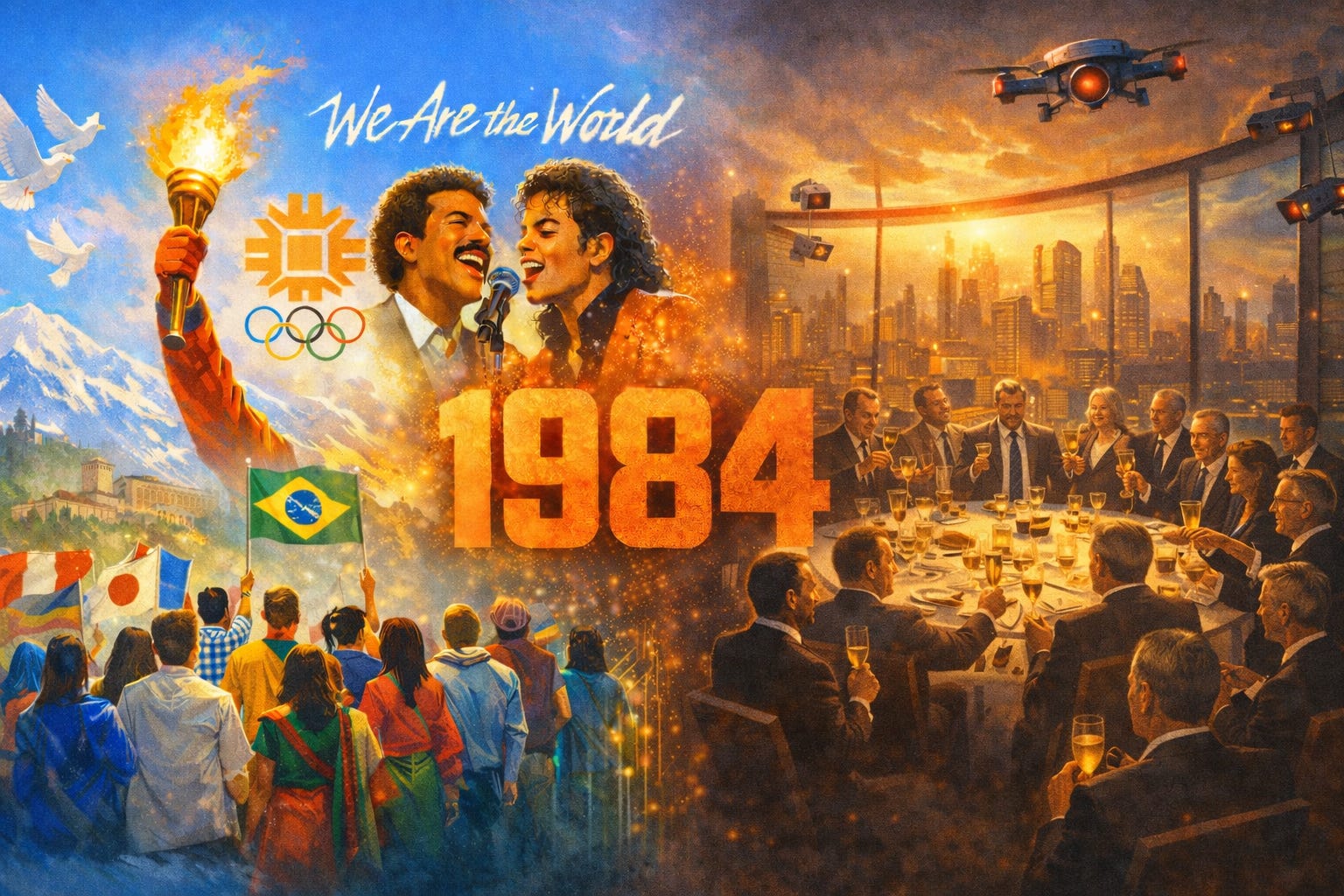
Last Sunday I watched the 2026 Winter Olympics closing ceremony on TV with athletes from all over the world, flags mingling together and the sense that we the people of the world are way more than what divides us.
With my dose of Olympic joy, I still wasn’t tired after the ceremony ended, so I watched The Greatest Night in Pop, a documentary about the making of We Are the World — the single co-written by Lionel Richie and Michael Jackson that brought together pop’s then biggest American stars to raise funds for African famine relief. The film meticulously recounts how, long before mobile phones, social media and instant messaging, the logistical hurdles that had to be overcome for a remarkable cast of artists to come together in one room, setting their egos aside, to pursue something larger than themselves.
It made me think about these two very different manifestations of “togetherness,” separated by four decades yet bound by the same instinct: that there’s so much we can accomplish, and overcome, when we just come together as one. As I reflected on the two programmes I just watched, memories surfaced of the very first Olympics I remember as a kid: the 1984 Winter Games.
It was then, when I was ten years old, when the world opened to me.
Sarajevo
It was the 1984 Winter Olympics in Sarajevo in then Yugoslavia (a co-founder of the Non-Aligned Movement as it were). I remember watching with my sister from our living room. I recall she loved the figure skating; I was oddly interested in luge, bobsled and slalom. But I mostly loved the human interest stories that were pulled together. I remember realising, perhaps for the first time, how very big the world really is. How different people really are. Different languages, different flags, different faces — and yet, for those two weeks, they gathered peacefully under one idea.
Higher. Faster. Stronger. Together — this word would only be formally added decades later but was already implied.
I grew that winter. The Games weren’t just sport. They were proof that the world, in all its diversity, could converge in joy, laughter and life. Ten year old me never saw the differences as division. At that age, I hadn’t yet grasped the fact that a different kind of competition could also mean war, empire and power.
Looking back, I think Sarajevo is what set me on the path to becoming a global citizen — finding home wherever I landed, finding that belonging was not determined by one nationality or identity. I guess I could say that 1984 was a bit of a threshold year. Less than six years later I’d leave on a Sabena Airlines flight – off to discover the world.
The year 1984 saw the planning start for gathering the biggest names in pop to record We Are the World. For a moment, culture and capitalism were bending toward compassion.
At the same time, across the Atlantic, Poland’s Solidarity Movement – Solidarność – continued its improbable resistance — workers, intellectuals, and ordinary citizens standing up to authoritarian control of narrative, resources and power. As a Polish family, we paid attention. Solidarity was not abstract. It was truth pushing back against machinery.
1984 was, in many ways, a year of many different facets of courage.
But it was also a year of shadows. There was another side to 1984. A dark side.
AIDS, Bhopal
The virus that would come to be known as HIV/AIDS was identified in 1984, but that did not prevent years of stigma and political neglect – and the deaths of tens of millions of people. Marginalised communities were left to suffer while conservative leaders hesitated. Silence became policy. It got bad. Really bad. So, in 1987 ACT UP was formed: Silence = death they yelled. Indeed, they were not silent.
In December, as Richie and Jackson were putting the final touches on We are the World, toxic gas leaked from a pesticide plant in India, killing thousands in what became known as the Bhopal disaster. It remains one of the worst industrial catastrophes in history — a case study in regulatory failure, corporate negligence and the human cost of technological systems operating without accountability.
1984 showed two sides of itself at once:
Cooperation and indifference.
Solidarity and impunity.
Shared humanity and disposable lives.
I did not yet understand this duality when I watched the Olympic flame burn in Sarajevo that year. But I would.
Less than a decade later, Yugoslavia fractured. I remember watching the evening news — this time old enough to comprehend what war meant. The same city that had symbolised unity became synonymous with siege. And death.
Years later, in my twenties, I read As Long as Sarajevo Exists by Kemal Kurspahić, the story of the newspaper Oslobodjenje that continued publishing during the siege, missing only a single day despite constant bombardments. That spirit of defiance — of insisting on truth and continuity under fire — inspired me. In hindsight, I see now that the editors and journalists of Oslobodjenje knew that the integrity of information was worth risking their lives for.
This all carried me into humanitarian work and international development. And they carry me now into AI governance.
And then there is the other 1984. The fictional one.
Nineteen Eighty-Four
In Nineteen Eighty-Four by George Orwell, the year stands for surveillance without accountability, language manipulated to obscure truth, permanent war used to consolidate power and technology deployed not to liberate but to control. “Big Brother” is not merely a tyrant; he is an information system. Reality itself becomes administratively managed.
When Orwell wrote the novel in 1949, 1984 was a warning — a date projected into the future as a cautionary horizon. Yet when the real 1984 arrived, it did not look like Oceania. It looked like Sarajevo’s Olympic flame. It looked like musicians crowding around a microphone to sing for strangers. It looked like workers in Poland insisting that truth still mattered.
And yet, the dystopian strand was there too.
Governments slow to acknowledge a deadly virus because it impacted the other. Corporations shielded from the consequences of industrial catastrophe. Star wars (not the movie). Political narratives hardening around fear and exclusion, especially in the United States where conservative, white evangelicalism began to grow deeper roots with Reagan’s landslide re-election that same year. .
Orwell’s genius was not in predicting the exact technologies of the future. His was in identifying a pattern: when power converges with information control, when fear becomes governance strategy and when truth is invented to serve authority, our institutions erode from within.
The novel’s enduring relevance is not about telescreens. It is about asymmetry — who sees and who is seen; who decides and who is decided for. That asymmetry seems to be increasingly the fault line of our current age of frontier technologies.
Twenty Twenty-Six
Today’s frontier systems do not resemble Orwell’s crude surveillance screens. They are far more subtle, far more capable, far more integrated into daily life. They curate and mediate information flows, predict and nudge behavior, optimise targeting — commercial and military alike. They are shaping us and our societies.
If the actual Bhopal of 1984 represented technology and capitalism without guardrails, Orwell’s fictional 1984 represented governance without accountability. AI sits at the intersection of both risks.
Today, frontier AI systems are being deployed at extraordinary speed. America explicitly seeks global dominance in AI. Corporations race to scale and cash-in with a new digital military-industrial complex that’s thriving from Washington to Tel Aviv, to Paris and Berlin, and to Beijing and London. Military applications proliferate. American diplomats are instructed to lobby against data protection laws abroad in the name of American competitiveness and dominance.
Underneath all this are the deeper questions of how to effectively address the risks of frontier technologies and prevent disasters from happening.
In 1984, industrial technology without adequate oversight led to Bhopal. Political indifference deepened the AIDS crisis. Power consolidated narrative control.
And yet that same year, artists collaborated across differences. Workers demanded dignity. Athletes embodied peaceful rivalry.
Technology and ‘innovation’ amplifies who we are. AI is our generation’s amplifier.
Are we building it in the spirit of the Olympics?
In the shadow of Bhopal?
Or in the imagination of Orwell?
The Olympic spirit assumes shared rules, referees and fairness. It assumes that even fierce competition operates within guardrails designed to protect human dignity. Bhopal represents the opposite: systems optimised for efficiency and profit without sufficient oversight, harms externalised and responsibility diffused.
In the AI domain, the stakes are even higher. These systems shape knowledge, labour markets, military targeting, financial flows and democratic discourse. They are our infrastructure.
If governed wisely, they could expand access to education, accelerate medical discovery, strengthen climate resilience and planetary health, and support more equitable growth.
If governed poorly or only by the most powerful, they risk deepening inequality, entrenching surveillance, accelerating autonomous warfare and enabling a new form of technocolonial extraction.
Some argue that this is simply the logic of geopolitics — that we are moving from Pax Americana toward something more fractured, more competitive, more unilateral. Toward a Bellum Technologicum. Perhaps. But this is precisely why governance matters. The question is not whether technology will shape power. It always does. The question is whether power will be constrained by shared norms.
This is where I find cautious hope.
1955 and the Spirit of Bandung
In 1955, leaders from Asia and Africa gathered at the Bandung Conference to articulate a non-aligned vision in a bipolar world. They sought autonomy, cooperation and dignity outside superpower rivalry.
Today, we need a similar spirit among middle powers — countries and coalitions willing to insist that AI governance be multilateral, rights-respecting and inclusive. Not anti-innovation. Not anti-growth. But pro-dignity. Governed by shared norms and rules.
A new spirit of Bandung for a pro-social digital age.
If AI governance becomes merely an extension of national power projection — a tool of digital unilateralism — then we risk repeating the darker side of 1984: systems built first, safeguards considered later.
When I think back to ten-year-old me watching the Sarajevo Winter Games, what I remember most is not the medals. It was the realisation that the world was larger than my immediate surroundings — and that difference did not preclude connection. Indeed, it inspired wonder and curiosity and joy.
