

Empathy Is No Algorithm
Lessons from the ER, the OR, and the People in Between

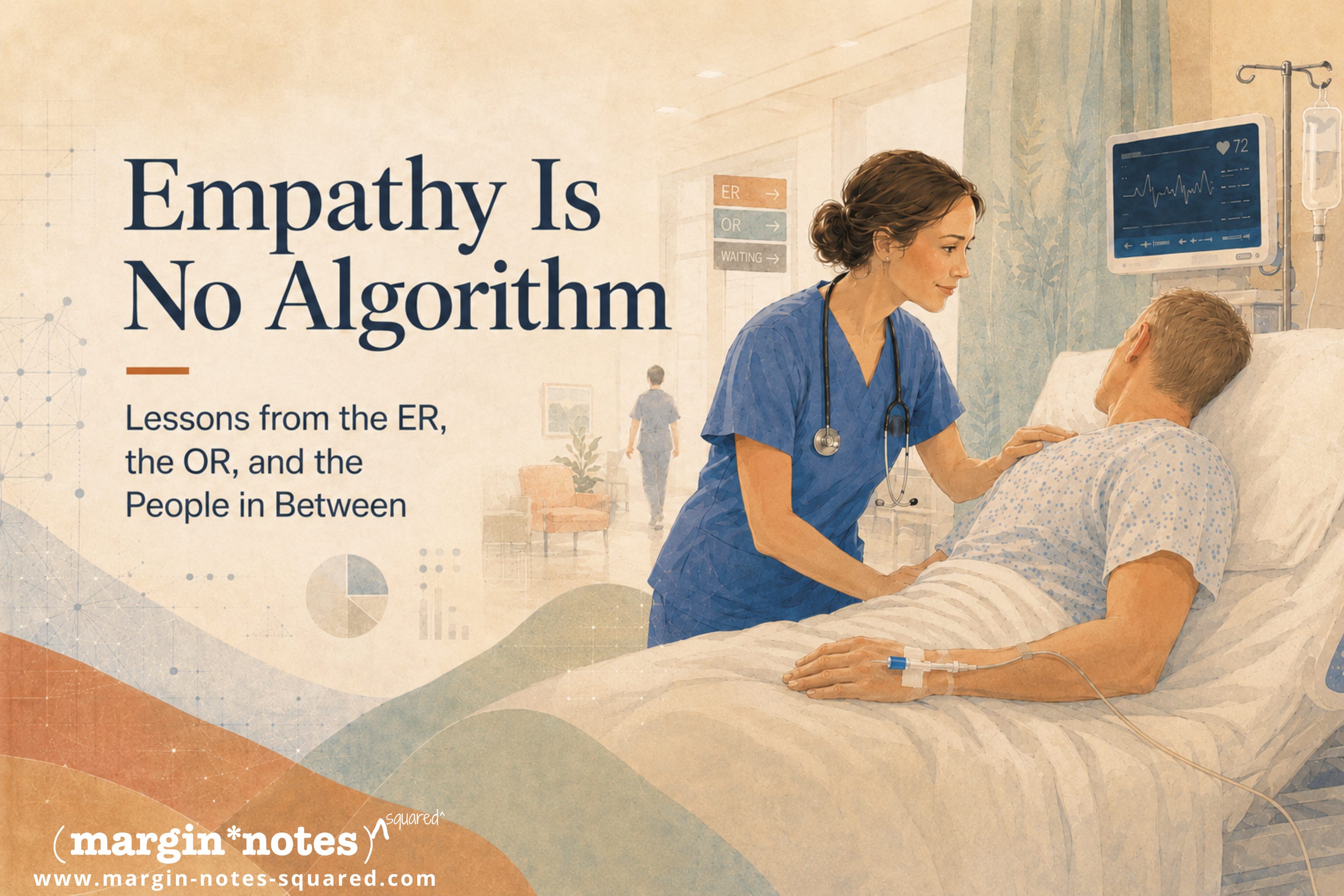
On a personal note: This edition is delayed — I was unexpectedly hospitalised. As it turns out, the experience became this article.
Just last week I’m sitting in an emergency room here in Germany, where I’ve been visiting friends. The pain has been building for ten days — an infection that turned serious enough to require urgent surgery — and I’ve arrived here, in a country whose language I don’t speak, facing something I’ve never faced before: general anaesthesia, a stay in hospital, surgery, my body in the hands of strangers.
I think about putting in my earbuds, but then I don’t. I reach for my book which I’ve of course brought with me (“From Bacteria to Bach and Back”) but I keep it in my backpack – not least because it’s a bacteria that’s causing me all this pain. More seriously, there’s something about the Emergency Room, the people in it, the diversity of humanity, the particular sensations that pain and fear produce when you let them. So I just look around and pay attention.
I try to breath intentionally. Simply sitting and observing the world of the ER around me feels a bit like surrendering to the conditions enveloping me, so that’s what I do. And my thoughts swirl and I realise something.
ER State of Mind
Across from me, a boy of perhaps ten or eleven arrives with who I presume is his grandmother. He’s wearing a football jersey — no doubt because of the World Cup. It appears that his shoulder is dislocated and he’s crying, whimpering really, the kind of crying you do when you’re trying not to because you’re supposed to be a “big boy”, but the tears are there nonetheless. His grandmother, more irritated than sympathetic it seems to me, leaves him sitting alone while she goes to move the car or do something. He waits there, mumbling in German. I’m told by my friend who accompanied me that he’s asking for something to make the pain go away.
I watch him, look at the football jersey, and I think, almost immediately, of Gaza.
I know that to most that will sound like a leap. But when you are scared and in pain in an emergency room — when you understand, viscerally, what it means to seek relief and not know if it’s coming — the distance between that child and the children in Gaza really quite dissolves. Emergency rooms are supposed to be a refuge, the place where the social contract holds even when everything else has broken down. You go there to be seen, to be helped, to be safe.
In Gaza, hospitals have been bombed and medical staff have been killed, purposefully. Patients have died in corridors when the generators ran out of fuel, often covered in a thin layer of white dust, as the building crumbles around them. Mind you, this has not happened by accident — it has happened with the assistance of AI-enabled targeting systems, weapons technologies that allow their operators to designate targets from a distance, without being in the room with what they’re doing. iSystems that process data and return coordinates. Systems from which the apprehension by the user has been, by design, removed. Those feelings just get in the way in any case. That all happens because policy has failed.
The boy’s mother arrives and he stops crying it seems. I think about boys for whom no mother arrives in time. Or ever.
The People Who Made Me Well
Over four days I’m in hospital, I watch the people who keep that hospital running. The nurses taking care of patients including me at three in the morning. The cleaners who come through like shadows and efficiently tidy up while the ward is still or just waking up. The orderlies, the catering staff, the doctors doing rounds with that look of people who haven’t quite slept enough. One nursing team handing off to the other. Showing up when I need them with a smile on their face asking how they can help.
Many of them — not all, but many — are clearly from diverse backgrounds. I notice this not to make a point of it, but because outside the hospital, out in the “real world”, in the political conversation happening across Europe, people who look like them or have names like them are being blamed for things they didn’t cause. The same governments that depend on their labour in hospitals, care homes, warehouses, and kitchens, point at them as the source of social problems. But these are the helpers, right? These are the people we look for when we are in distress, in pain, or in danger: the helpers. Look for the helpers. Always look for the helpers, as Mr Rogers famously told us as children.
This made me think about structural invisibility, the kind that should be familiar to anyone who follows the technology sector and the policymaking that is meant to guide it. The people doing the essential, unglamorous, irreplaceable work are written out of the story that progress tells about itself. The tech industry celebrates AI breakthroughs while Global Majority workers who label data, moderate content and make those breakthroughs possible are never in the room when the awards are handed out. The far right scapegoats migrants while the healthcare system just simply depends on them to function. The helpers make it all work.
And if the helpers doing all this irreplaceable work are also the people with the least power in the societies they serve, what does this tell about what we value? What does it say about our policymaking?
Foreigner
I have never felt more foreign, more outside, in my life than I did in that hospital. Not because anyone was unkind — quite the opposite. But the system had invisible assumptions baked into it: about who you are, what you already know, how a German hospital works, how information flows, what questions to ask (what not to ask), what your rights are, how food will be delivered, visiting hours. I showed up with basic essentials, not knowing what I’d need to bring myself for a stay in hospital: what devices, extension cords, clothes, snacks even. None of this was explained. It didn’t need to be — for someone who grew up in this context, it simply exists as background knowledge.
For me, it produced a lot of low-level anxiety that permeated much of the entire experience. Even simple interactions — a form to sign, a question from a nurse — carried an extra cognitive load, because I couldn’t be certain I was understanding correctly or that google translate was properly conveying the meanings.
And here I want to be careful not to overstate this parallel. My experience in a German hospital is not the same as what a global majority user experiences navigating AI tools built in California. The stakes and the power dynamics were different. But the mechanism — a system built on invisible assumptions about who you are, what you need, what you’re capable of — is recognisably similar. For me it lasted four days. For billions of people using technology not designed with their lived experiences in mind, it is permanent and structurally embedded.
Pain
In the days before I went to the emergency room, I could barely walk. The infection had become severe enough that standing up sent blood pressure rushing to the site of the infection, and the only way to manage it was to hunch forward and move slowly, taking small steps, stopping often. It hurt. It was embarrassing. I was conscious of people watching me, of being slow, of being in the way.
I have, in my healthy life, been impatient with people who walk slowly. I have sighed, internally if not audibly externally, at those who take up too much space or move at the wrong speed. I will not do it again — not because I’ve been told not to, but because I now know, in my body, what it feels like to be that person. The embarrassment of it. Even the shame. The effort. The difference between how you want to move and what your body allows you to. It’s in my bones now.
This is what empathy actually is: not a sentiment, but a form of knowledge. It lives in the body. It is produced by experience, not instruction. You cannot lecture someone into it. You have to become it.
Since the surgery, I’ve had to give myself daily injections in my abdomen to prevent thrombosis. The first time it took me more than a hour of hesitation, and if I’m honest, no small amount of tears and frustration and fear of pain. I couldn’t help but recal that a year or so ago, I was helping a friend’s daughter do a similar injection and she was so frightened of the small needle that she was crying and kept refusing. I remember being impatient with her. I know exactly how she felt now. The knowledge is not abstract. It is in my hands each time I use my fingers to push the jab myself.
Back at the hospital, before the surgery itself, in the pre-op room where the anaesthesia is administered, something happened that I want to describe accurately because I think it matters.
The anaesthesiologist positioned herself so that she was looking directly into my eyes. This required her to physically adjust her posture. She saw that I had tears and my face was distressed. She asked what was wrong. I told her: I had never done this before – never had a surgery, never had general anaesthesia and never stayed in a hospital. I didn’t know what would happen. My points of reference were non-existent. And I can’t understand anything around me. I told her that I was anxious and nervous and frightened.
She looked at me — still directly, still without looking away — and she said:
“You can be nervous. You have every reason to be nervous. But do not be afraid. Let me take care of that.”
The fear left me. Not because she told me not to be afraid in the abstract, but because she refused to minimise what I was feeling while simultaneously offering herself as the answer to it. She validated the difficulty and then chose to absorb it on my behalf. That is not a skill you can automate. It is not a response you can optimise. It requires a human being to be fully, attentively present — to read another person accurately enough to know what they need to hear, and to respond meaningfully and with intention.
I was unconscious for the next while. When I came around, she was there.
The Epistemology of it All
For four days I was, in some partial and temporary sense, Siti, the fictional person I created in these pages recently.
Well, not exactly: I had resources and privileges she doesn’t have, and I want to be careful not to minimise that distance. But I was navigating a system not built for me, in a language I didn’t speak, without the background knowledge the system assumed I had, without the affordances I needed to thrive under the circumstances. I was dependent, vulnerable, and slow.
If you’ve read my previous piece on AI access and inequality — on the gap between the AI-augmented and those left behind — you’ll recognise Siti. She is the young woman with just a cheap Chinese smart phone and a fellowship deadline, competing against a peer with a laptop, a second monitor, and paid access to every premium generative AI tool necessary to excel. The structural conditions of her life make responsible AI use nearly impossible not because she lacks capability, but because “the system” was never designed with her in mind.
The people designing those systems and even the policymaking at a global level that is shaping them — the engineers, the product managers, the founders, the multilaterals, the Western governments — are not Siti. They are, disproportionately, people who have figuratively never walked hunched over in pain, never been foreign without language in an emergency room, never given themselves injections while caring for younger siblings in a crowded house. They have not had the experiences that generate the empathy required to jump out of your own skin to design for lives unlike their own.
This is not a diversity argument I’m trying to make right now, though I suppose it actually is that too (and something I’d also advocate for). I just want to focus on the epistemological one. Empathy is a form of knowledge. And if the people building our technological systems have a narrow base of lived experience, the systems they build will encode that narrowness at scale. The assumptions will be invisible — just as the German hospital’s assumptions were invisible to me and the affordances they had weren’t recognisable to me either — because to the people making them, they simply look like reality.
For me, the thoughts I keep returning to aren’t just about who is building and shaping these systems through innovation and policy. Rather, I’m concerned about what lived experiences they are drawing on and what are we giving up when we let “them” decide which are worth keeping and considering? And as their systems optimise out inconvenience and nervousness and even fear, how much are our empathy muscles deteriorating? What’s the impact on our ability to empathise, to store that knowledge in our bones?
Empathy
To build AI systems that centre us as human beings, we need empathy. And empathy is the raw material of human development itself: the friction, difficulty, surprise, discomfort, serendipity that we encounter when systems don’t smooth everything away.
The anesthesiologist who saw my tears and chose not to look away — that moment existed because of difficulty. She had trained to be present in exactly that kind of moment. The knowledge she brought to it was not in a database or textbook or algorithm. It was in her. In her humanity.
So two things, as I close this piece — one personal, one systemic.
The first: cultivate your empathy actively and deliberately. Lean into the uncomfortable encounters, the inconvenient moments, the experiences that take you outside the frictionless path. They are not inefficiencies. They are how we become capable of seeing others. They help us evolve.
So, that bacteria book in my backpack, I read this bit yesterday which seems somewhat apropos now:
“Human chess players have to control their hunger pangs, and emotions such as humiliation, fear, and boredom, but computers can finesse all that with impunity, can they not? Yes, but at a large cost, says Deacon: by taking these concerns off their hands, system designers create architectures that are brittle (they can’t repair themselves, for instance), vulnerable (locked into whatever set of contingencies their designers have anticipated), and utterly dependent on their handlers.”
— Daniel C. Dennett, “From Bacteria to Bach and Back: The Evolution of Minds”, citing Terrence Deacon, p. 158.
Put down the earbuds. Look up. Let the difficult thing be difficult. And experience it. They help us grow our empathy and evolve.
The second: be deeply suspicious of technology and the policymaking that allows technology to systematically optimises away challenge, surprise, discomfort, and the unexpected. Every time a system smooths out a difficulty, ask who decided that difficulty wasn’t worth keeping. Ask what knowledge was encoded in that decision, and whose experiences were in the room when it was made. Because we will pay for the loss — in our capacity to relate to each other, and in our capacity to build the systems that human flourishing actually requires.
The divide between the AI-augmented and the non-augmented is real, and it is widening. But underneath it is a more insidious divide: between those whose lived experiences are shaping how technology is built and how its trajectory is shaped, and those made dependent on those technologies whose experiences and cultures and languages and norms are being optimised away without anyone asking permission.
The boy in the football jersey wanted something to make the pain go away. So did I. So does everyone who ends up in an emergency room, in any country, in any language. That shared vulnerability is not a bug in the human experience. It is the source of everything that makes us capable of caring for one another. And for AI to serve our flourishing, our desires, our well-being – in short, the good life – we need empathy.
We need empathy. For technology. For policy. For us.