

Food Deserts. Or Just Deserts?
On the AI-augmented and the left behind

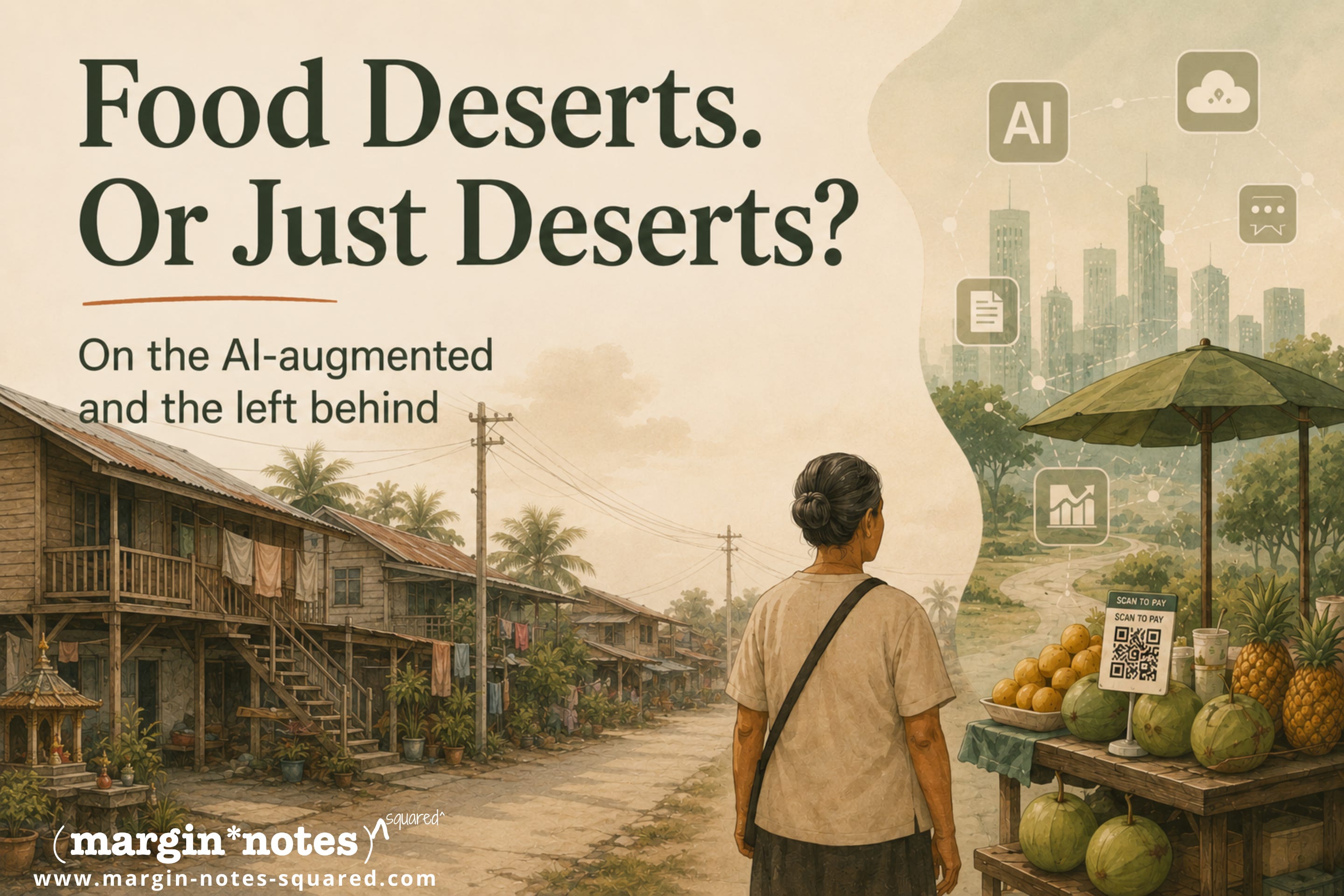
Near my house I often encounter an elderly lady who runs a fruit stand. A pretty grueling job for an older woman, I can imagine. But she’s always all smiles and makes the most delicious coconut smoothies for me — not too sweet and with plenty of coconut meat. The perfect boost on a hot day, which is every day. I pay her using a QR code to transfer money to her. To keep her records, she takes a snapshot of my payment confirmation with her mobile phone. It’s pretty old and beat up; the screen is scratched and almost impossible to see clearly when there’s a glare, made more difficult by the fact that I’m certain she needs eyeglasses but likely can’t afford them. I inevitably have to sort it out. We smile and chat a little; then I’m on my way.
One hundred and fifty-two million Southeast Asians are fully analogue. That’s roughly 22% of the population of the region who have yet to come online with their own devices. For those who’ve marginally joined the ranks of the global connecterati, many are mobile-first — they went straight to mobile devices, skipped the fax machines, desktops and laptops, and found the world in the palm of their hand. Social media, messaging apps, e-commerce, information search, and now generative AI. All in that tiny little device. Just like the lady who makes my coconut smoothie.
“Mobile first” is a curious term.
It’s a concept popularised by global development organisations like the World Bank and UNDP and cultivated by global tech companies targeting emerging markets. Their comms teams aimed to signal some sort of endearing story around structural advantage — a leapfrogging — that has erroneously painted places like Asia as benefiting from technology’s graces in ways that the old world can only admire.
The trouble is, that story papers over a great deal. People in Myanmar were so mobile-first they even skipped the open internet and went straight to the curated world Facebook gave away through Free Basics and a stripped-down version of the app called Facebook Flex. For Myanmar, mobile-first was Facebook-first. And that was deadly, as we all now know.
Which Asia?
So when I read articles — and there is no shortage of them — applauding an undifferentiated ‘Asia’ for moving beyond adopting innovations developed elsewhere, breathlessly cataloguing the region’s tech prowess and export ambitions, I gotta ask: which Asia are they talking about?
Certainly not the mobile-first citizens I’ve encountered in villages and towns across the region. Certainly not the lady making coconut smoothies.
They mean corporate Asia — the large multinationals and family conglomerates headquartered in Bangkok, Jakarta, Manila, Cyberjaya, and Singapore, where capital speaks and “innovates” on the back of supply chains that often rely on invisible digital labour: the content moderators, data labelers, workers whose efforts train the very models now being celebrated.
They are talking about certain groups of people in the region, not everyone. This matters a great deal because the story we construct — the extremes we tend to smooth out into averages and whole numbers — about who benefits from technology, and how that happens, and how widespread that is, shapes the policies we make and the investments we prioritise.
A Geography of Absence
We’ve all heard about the real and potential harms embedded in AI systems. The risks of bias and discrimination in AI-enabled hiring, credit, healthcare, education and much else. This is all true.
But I want to talk about something I think is a bit more fundamental: the AI tool itself as a site of inequality. As an impediment to what philosophers call the good life — what makes a human life truly worth living.
I’m not talking about what AI does to you. I’m talking about who can afford AI for themselves.
I’m not a neo-Luddite. I use these tools. I’ve found Claude and ChatGPT genuinely useful for navigating spreadsheet coding, finding information that would have been nearly impossible to locate through standard search queries quickly and identifying common ground across long and complex documents. All things I can imagine being invaluable for anything from peace negotiations to closing difficult deals to even putting together funding applications for an NGO. I’m a voracious reader, and even I have to admit these tools have augmented what I can do and how fast I can do it.
Yet, I’m concerned about who gets to use them safely and well, and who doesn’t. Because when you use them safely, you advance and seize opportunities. When you can’t, you don’t.
Think of it like eating. A balanced diet of fresh vegetables alongside whatever processed foods you happen to enjoy is perfectly sustainable. Everything in moderation. But what happens when your options are restricted, or worse, restricted by forces entirely beyond your control? When you are structurally prevented? That’s what we call a food desert: a geography of absence, where entire communities simply don’t have access to affordable fresh produce and healthy food options. Not because of their choices. Because of their circumstances. Where I live, this might manifest as someone who can only afford cheap instant noodles for dinner most days or relies on cheap (but salty and oily) prepared foods.
Recently, after a yummy dinner of Japanese food, a friend spent some time telling me all about Claude’s Cowork capabilities and how useful he’d found them in his accounting and compliance work. I dove in, being the spreadsheet nerd that I am, and found that these tools could save me hours I could put towards more reading, more rest, more work. How absolutely amazing is that?
In fact, it really is absolutely amazing if you have the money to pay 3,000 Baht a month for a premium subscription. It really is absolutely amazing if you have the bandwidth for image generation and the hardware to make everything run smoothly, like an external monitor and laptop where you can run peripheral applications. But what happens when you don’t have the bandwidth? When the bank account doesn’t stretch that far (or you don’t have a credit card)? When your only device is a 15x7cm screen and your fingers?
You start to find yourself on the wrong side of the AI divide. And that has material consequences — for your success, your productivity and your ability to realise your own human flourishing.
Meet Maya and Siti.
Both are ambitious young women with STEM degrees from solid universities — not top tier, but good enough, and earned through real effort. They both are keen on frontier technology and its risks, but neither have practical experience outside work they did in their undergrad labs. Both have just found out about a prestigious international fellowship that would most certainly help them jumpstart their early careers. The research essay is due in three days.
Maya works from a quiet apartment, just above a fashionable and well-stocked supermarket. At her desk by the window the city spreads out below her. She has a laptop connected to an extended monitor, a fast and reliable internet connection with quality wifi throughout her house, a cloud storage subscription and paid access to both ChatGPT and Claude. She opens the fellowship brief on one screen and a blank document on the other. She talks through her ideas with Claude, refines them, asks it to surface related literature. She finds a quote that looks useful and immediately cross-checks it: opens a third tab, searches the original source, verifies the citation, checks the context through key word searches in the PDF programme. She catches one that’s subtly incorrect and one that is just very wrong, made up in fact. She fixes them. She iterates. Three days later, she submits a tightly argued, well-sourced essay as an elegant PDF file that is as much her original ideas as it is enhanced by the tools she used. She is very happy and rings up her friends to grab a nice dinner to celebrate.
Siti lives at home with her family, in a traditional wood structure close enough to the neighbours that she can hear them arguing through the thin walls. Her parents are working — at a content moderation facility as contractors, as it happens — and she is the primary caregiver for her younger siblings for much of the day. She has a phone: a recent, affordable Chinese model with a small screen. DeepSeek came installed. She has a few tokens left for image generation in another tool. There’s no wifi at her home, but usually the 5G signal works on her phone, but only in specific locations in the house, none of which are particularly comfortable or quiet. She can use the shared community connectivity down the street, but it’s always crowded and loud with children looking for somewhere to play.
She reads the fellowship brief on her phone. She starts drafting but its slow going, typing with her fingers. She asks DeepSeek for help structuring her argument; it produces something reasonable. She tries to verify a reference it has given her — but switching between the draft and a browser tab and back again on a small screen, interrupted by a sibling who needs something, is genuinely difficult. She gives up after a few attempts, mostly out of frustration because she realises she doesn’t have enough time to do all this on her small device. Besides, it’s just small details that no one would really dig too deeply into. The shortcut is not laziness. It’s the rational response to her constraints. She submits something. It’s not her best work. It may not make the cut. She starts to feel depressed and sad.
Here’s the thing: Siti didn’t fail because she was less talented, or less prepared, or less motivated, or less literate with AI-enabled tools. She failed — or at least competed at a structural disadvantage — because the conditions that make responsible AI use possible were not available to her. Safe use of these tools requires the ability to verify, cross-check and interrogate. That is greatly facilitated when you have multiple screens, a stable connection, and uninterrupted time. It is severely hindered when you are working on a small phone in a crowded house with spotty 5G, trying to flip between tabs with big fingers and a caregiving interruption every twenty minutes.
The device shapes the behaviour. The circumstances determine the outcome.
In the short run, this is about competition. You cannot compete with other people or organisations that can fast-track proposals with AI-powered precision. You cannot compete with those who can move at speeds that were simply not humanly possible two years ago. You cannot compete if you are spending hours troubleshooting a spreadsheet while someone across town asks their premium model to fix it in two minutes. These are not minor inefficiencies.
In the long run, they compound and accumulate the harm of exclusion. And it is not simply a question of wealth; it is geographic and infrastructural. The gap between Bangkok and rural Isaan, between Jakarta and Papua, is seen in who has access to premium AI tools and enabling devices, and who gets left on the margins to try as hard as they can just to keep up, but always seemingly falling short.
A Moral Lighthouse
I’ve been reading a lot of philosophy lately — not as an escape from these problems, but as a way of grappling with them more honestly. I’ve come to believe that the solutions we need are not simply technical, and not only political. They are importantly philosophical, in the sense that the moral lighthouse matters more than it first appears — and much more than when I first wrote about it here.
Martha Nussbaum’s work on political love and political emotions has given me a language for why justice requires more than rules — it requires the cultivation of certain kinds of feeling, certain orientations toward the lives of others. John Rawls and Amartya Sen, in different ways, have deepened my thinking about what just outcomes actually require — not just formal equality of opportunity, but genuine attention to the conditions that make flourishing possible. And from liberation theology — from Gustavo Gutiérrez and, now, from Leo XIV’s Magnifica Humanitas — comes the concept I find most compelling of all: the preferential option for the poor and most vulnerable. Not charity or pity. But rather a structural commitment to centring the lives of those most at risk in every decision we make.
These perspectives don’t solve the AI divide. But they cast it in an important new light that matters. They force us to ask not “how do we manage the transition?” but “what does justice look like for Siti? What does her flourishing require?”
We don’t yet fully think of AI as a public good. But we should. We once didn’t think of electricity, running water, or roads that way either. Societies made deliberate decisions that these things were too fundamental to leave entirely to the market. Investment went everywhere, including where it cost more.
The analogy isn’t perfect. But it speaks directly to the absence of preferential options for the vulnerable in our current AI moment — and to the gap between the rhetoric of universal benefit and the reality of structurally unequal access.
And the looming and under-appreciated crisis of the AI-augmented versus the non-augmented, and what that means for the future of humanity.
Just Deserts
“Just deserts.” The philosophical idea that people receive what they have earned — that hard work and good choices produce deserved rewards, and that those who fall behind have, in some meaningful sense, done so by their own actions. It is a seductive story. It is also, more often than not, a story the comfortable tell themselves.
Siti is not receiving her just deserts. She is receiving a food desert — a landscape of restricted options, artificially constrained by forces she did not choose and cannot easily change. The same is true of the 152 million Southeast Asians still fully offline. The same is true of the coconut smoothie lady with the scratched phone and the need for glasses she cannot afford.
We will not get everyone an extended monitor and a view of the city. But we can, as a society, make a decision: that AI augmentation does not become the new mechanism of sorting, the new logic of just deserts for those whom the proper tools needed to compete remained inaccessible.
We can decide that the benefits of this extraordinary technological moment do not trickle down in the same ways that economic benefits have always failed to trickle down.
The divide between the AI-augmented and the non-augmented will become one of the defining fault lines of our world — determined not by talent or effort, but by the access and enabling devices.
For that, we need Nussbaum’s political love, Rawls’ and Sen’s theories of justice, and Leo XIV’s preferential option for the most vulnerable. We need a moral lighthouse. Not to feel better about ourselves. But to find our way — and to build the digital world where the good life is possible for all of us.
The coconut smoothie lady is real — she’s there every morning, squinting at a scratched screen, doing what she has to do.
Siti is fictional, a product of my imagination. But millions of people like her across the region are not. We don’t have to ask whether they deserve better, because we all know that they do. They aren’t waiting for the world to notice them, to see their lived experience.
But, we most certainly need to build a digital future that does.