

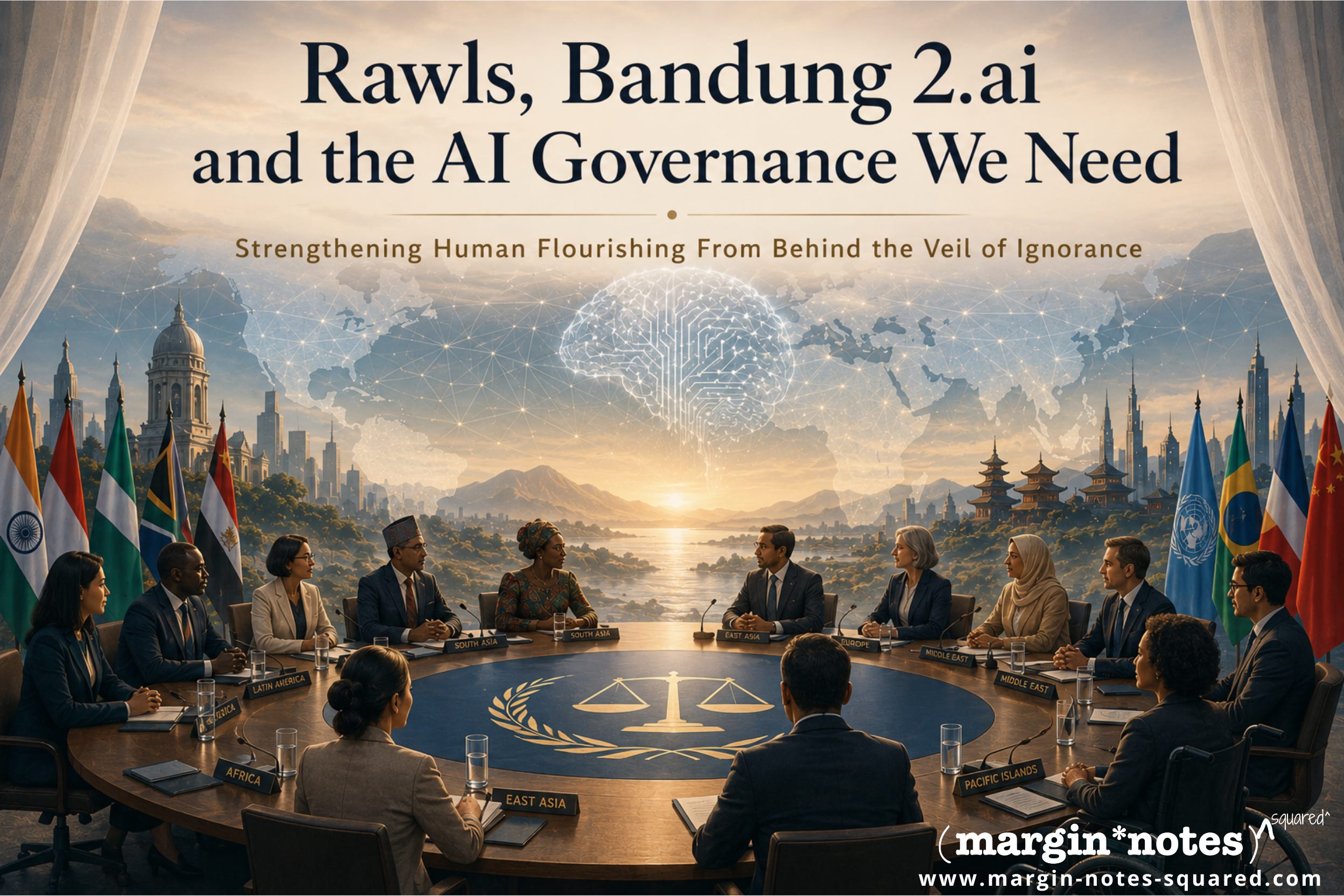
Rawls, Bandung 2.ai and the AI Governance We Need
Strengthening Human Flourishing From Behind the Veil of Ignorance

A brief housekeeping note: I took a short break in May to spend time with visiting family. It was a welcome recharge, but I'm now back to regular posting and keeping an eye on AI governance, policy, and research events, news and insights across the region.
I recently finished The Monarchy of Fear, a book by philosopher Martha Nussbaum. It’s been on my bookshelf for years, ever since I shelved my PhD aspirations. I picked it up earlier this week and I read it in two days flat. In the book, she explores how fear, envy and resentment shape our political lives. These emotions do not merely influence us as individuals, but they also influence nations. Fear can distort judgment, narrow our moral imagination and push societies toward competition when cooperation would better serve the common good.
As I read her book, I found myself naturally drifting towards what I work on mostly these days: governance of artificial intelligence and frontier technology.
When I stop and think about it, much of the contemporary discussions about AI are often driven by fear. Fear of falling behind. Fear of losing economic advantage. Fear that another country will develop more powerful systems first. Nowhere is this more visible than in the growing competition between the United States and China.
The dominant narrative is simple: AI is a race. The goal is to win.
Yet, I think this narrative is leading us in the wrong direction. If artificial intelligence is truly a transformative technology (it is), perhaps even a civilisation-shaping one (it very well might be), then we should pause and ask a more fundamental question: What would a just system of AI governance look like?
To answer that question, I find myself returning to the work of another philosopher, John Rawls, and his momentous book A Theory of Justice where he ambitiously pursues “justice as fairness.” Rawls proposed a famous thought experiment known as the veil of ignorance. It goes like this: Imagine that you are designing the basic rules of society. You must choose the institutions that will govern everyone. However, there is one condition. You do not know who you will be once the system is in place.
“Let us review briefly the nature of the original position… To begin with, the veil of ignorance excludes all knowledge of likelihoods. The parties have no basis for determining the probable nature of their society, or their place in it. Thus they have no basis for probability calculations. They must also take into account the fact that their choice of principles should seem reasonable to others, in particular their descendants, whose rights will be deeply affected by it. These considerations are strengthened by the fact that the parties know very little about the possible states of society. Not only are they unable to conjecture the likelihoods of the various possible circumstances, they cannot say much about what the possible circumstances are, much less enumerate them and foresee the outcome of each alternative available.” (p. 134-5)
A Theory of Justice, by John Rawls
This means: You do not know whether you will be rich or poor. You do not know your race, gender, religion, nationality, sexual orientation or social status. You do not know whether you will belong to the powerful or the marginalised. You don’t know what your vocation will be. Because of the very fact that you could end up anywhere in society, Rawls argued that rational people would choose rules that are fair to everyone.
This thought experiment has traditionally been applied within individual societies. I’m not a philosopher, but I think the rise of artificial intelligence invites us to think on a global scale and to draw from as many tools we have available to us as possible. This is one.
IMAGINE
Imagine for a moment that world leaders had to negotiate the future of AI from behind a veil of ignorance. They can guess that AI will generate enormous wealth or that it may alter the balance of power between nations. They can even guess that it could transform labor markets, political systems, cultures and military capabilities.
What they do not know with certainty is where they will stand once these transformations unfold. They do not know whether they will represent the dominant AI power or a technologically dependent (or subordinate) state. They do not know whether they will belong to a wealthy society that controls frontier models or a “poorer” society that relies on technologies developed elsewhere and provided as a gift. Perhaps most importantly, they do not know whether they will shape the future of AI or merely live under systems designed by others.
I wonder, what principles of governance would they choose?
I suspect the rhetoric we are hearing today would be rather different. I also suspect that they would choose something quite different from the narratives currently being pushed by (mostly, but not uniquely) private actors. They’d surely take pro-social AI not only seriously, but as the basis for deliberations on what kind of AI humanity actually wants, and how our governance efforts can bring it about.
Most importantly, they would likely reject a world in which a handful of generally homogenous actors are able to unilaterally determine the technological future for the diversity of humanity.
This is where another historical event becomes relevant.
Bandung
In 1955, leaders of post-colonial nations from across Asia and Africa gathered in Bandung, Indonesia. They came together in the aftermath of a long history of colonialism to assert a simple but powerful idea: The peoples of the world should have a voice in shaping the systems under which they live.
Leaders of India, Burma, Ghana, Egypt, and more came together in Soekarno’s Indonesia. They were neither Soviet stooges nor American pawns. They saw themselves as architects of a new world in which they could breathe freely and act independently. They came together to chart a middle way: rooted in justice, equity, and sovereignty.
“[W]e are united, for instance, by a common detestation of colonialism in whatever form it appears… How is it possible to be disinterested about colonialism? For us, colonialism is not something far and distant. We have known it in all its ruthlessness… Colonialism has also its modern dress, in the form of economic control, intellectual control, actual physical control by a small but alien community within a nation. It is a skillful and determined enemy, and it appears in many guises. It does not give up its loot easily. Wherever, whenever, and however it appears, colonialism is an evil thing, and one which must be eradicated from the earth.”
Indonesia’s President Soekarno, opening speech to the Asian-African Conference, Bandung, Indonesia,1955
The Bandung Conference is often understood as just a moment in post-colonial history, the precursor to the Non-Aligned Movement (NAM). It certainly was that. Yet its deeper significance extends beyond that context (one that I’ve written about in these pages before).
At its core, Bandung was a challenge to concentrated power. At the time this was the power enjoyed by former colonial empires. It demanded that those who are affected by political and economic systems should have a say in their construction – and when they are unjust, those systems must be changed.
This, I think remains quite relevant today.
The risk posed by AI is not simply that one country might become more powerful than another. The much more significant risk is that we create new forms of domination. Colonialism was one form of domination. It concentrated power in distant capitals while extracting resources and wealth and brain power from elsewhere. It drew those from the margins like a magent to the periphery, compelling them to conform and ultimately serve the empires that dominated them.
The AI age may produce different mechanisms of domination, but some of the underlying dynamics are quite familiar. A small number of firms and states may control the compute infrastructure upon which others depend. A narrow set of languages and cultural perspectives may shape systems used by billions of people. Data generated around the world may be transformed into value that flows primarily to those who already possess economic and technological power. And the bright thinkers from the margins migrate to the imperial center, if only to find compensation and recognition for their knowledge and insights.
AI recreating colonialism exactly as it existed in centuries past is not the challenge we face today. Instead, our challenge is that AI could create new forms of dependence, exclusion and hierarchy if we fail to govern it wisely – and that means justly.
Historical Memory Behind the Veil
Rawls’ veil of ignorance asks us to imagine a future position we cannot yet know. We are to design institutions without knowing whether we will emerge among the winners or the losers. We do not know whether we will be powerful or vulnerable, wealthy or poor, dominant or dependent. Because we lack that knowledge, we are encouraged to choose principles that are fair to everyone.
Yet there is an intriguing possibility that arises when this idea is taken globally, in our age of artificial intelligence.
For many of the world’s wealthiest countries, the possibility of not coming out on top remains largely hypothetical in their minds. Their modern histories have been shaped by economic strength, geopolitical influence, military might and technological endowment. While there have certainly been setbacks and periods of decline, many of these societies have relatively little recent experience living under systems designed and controlled by others.
Much of the Global South has a different historical memory.
For billions of people across Asia, the Pacific, Africa, Latin America and the Caribbean, the experience of colonialism was precisely the experience of living within institutions designed by distant powers. Political authority, economic rules and political structures were often imposed rather than negotiated. Decisions were made elsewhere while the benefits that frequently flowed outward created costs that were borne locally.
It is not my intention to romanticise this history or confer some kind of moral superiority. But in this experience, I think it may offer something equally valuable to humanity.
Perspective.
Rawls asks us to imagine what it would be like to occupy a less powerful position within society. Colonial history reminds much of the world what that experience actually felt like. Rawls’ veil of ignorance is a philosophical exercise in uncertainty. For many societies, the experience of asymmetrical power relations is not an abstraction but part of historical memory.
This is non-trivial because the central challenge of AI governance has never been simply technological, but political: Who will design the rules? Who will control the infrastructure? Who will benefit from the generated wealth? Who will bear the risks when things go wrong? Whose environment will be damaged? Whose culture will be crowded out?
Pause and reflect for a moment:
These questions sound remarkably different when asked from the perspective of those who have historically exercised power and those who have historically lived under it.
What seems to have emerged around us is this assumption, almost taken for granted, that leadership in AI governance should come primarily from those at the technological frontier. There is some logic to this. The countries developing the most advanced systems have invested substantially in developing the expertise that the world needs. They are closest to it. Their knowledge is useful.
But technical expertise per se is not the only form of knowledge that matters. There is also knowledge that emerges from lived experience.
Societies and communities that have lived through colonialism, dependency and exclusion often possess a heightened sensitivity to how power operates. They understand what it means to have rules imposed rather than negotiated. How economic dependency can become political dependency. How systems that appear equitable can produce profoundly unequal outcomes. And they know how powerful the margins can be through collective action.
This is where the spirit of Bandung becomes especially relevant and where Bandung 2.ai gains lift.
Remember, Bandung was not merely a gathering of newly independent states. It was a demand that those who live under global systems should have a meaningful role in shaping them. Those in Bandung in 1955 insisted that legitimacy requires voice. Active participation.
Seen in this light, Bandung 2.ai is not a call for the Global South to replace one set of dominant powers with another. It is a call to ensure that the perspectives of the historically governed are present equitably and substantively at the table as humanity designs the institutions and frameworks that will govern an artificial intelligence meant to serve the needs of all people everywhere.
I think the connection to Rawls is much deeper than it appears at first blush.
The veil of ignorance asks us to imagine that we may not emerge among the winners of history. The experience of colonialism reminds much of the world that this possibility is not merely theoretical. Perhaps this is why the countries and peoples shaped by that history have a uniquely important contribution to make. Not because they possess all the answers or because they are immune from pursuing their own interests. But because they carry historical knowledge about what happens when power becomes concentrated and abused, and when those subject to its consequences are excluded from its design. This isn’t a moral authority, it’s an epistemic contribution to humanity.
If artificial intelligence is to serve humanity as a whole, then the future cannot be negotiated solely by those who expect to dominate it. It must also be shaped by those who understand what it means to live with the consequences of decisions made elsewhere and projected onto them.
The Case for Bandung 2.ai
This is why I believe the spirit of Bandung remains very important today. Not because the world should divide itself into old categories of North and South. And certainly not because every contemporary inequality is identical to colonialism.
Rather, I believe it is important because Bandung reminds us to ask whose presence – bodies, minds, expertise, experience, wisdom, culture – are missing from the room.
I’m suggesting here that when combined with Rawls’ veil of ignorance, the spirit of Bandung – through a Bandung 2.ai – offers something pretty powerful. Rawls asks us to imagine that we do not know whether we will be among the powerful or the powerless. Bandung reminds us what the world looks like from the perspective of those who have historically lacked power. Together, they encourage a form of political humility that is often absent from contemporary discussions of AI.
This perspective also challenges the assumptions behind great power competition.
The United States often approaches AI governance from the position of a current (democratic, and therefore legitimate) leader. Some say China increasingly does the same. Both may seek advantage and influence. And both certainly may seek to shape the rules of the emerging technological order.
Yet neither can know with certainty where it will stand in ten, twenty, fifty, or one hundred years.
History is filled with powers that assumed their dominance would last indefinitely. Few of them were correct. A genuinely just framework for AI governance would require nations to design institutions they would be willing to live under even if they themselves eventually became weaker. It would require leaders to ask not what rules benefit them today, but what rules they would consider fair if circumstances changed tomorrow.
That of course is a difficult question. But, frankly speaking, it is really a necessary one.
Artificial intelligence may become one of the most consequential technologies humanity has ever created. Its benefits could be extraordinary. But let’s not forget that its risks could be equally profound.
It is imperative that the institutions and frameworks we build today to govern frontier technologies must be firmly built upon equity that serves humanity, with shared responsibility and shared benefits. This is what will create a just future for all.
As Nussbaum reminds us, fear encourages us to race ahead with distorted judgement, a narrow moral imagination and unrelenting competition. Rawls encourages us to practice humility and the spirit of Bandung encourages us to practice solidarity. It may be that humanity needs all three lessons as we work to govern artificial intelligence in ways that are equitable and in service of human flourishing.
A parting thought…
Imagine entering negotiations over the future of AI without knowing whether you would be American or Chinese, powerful or weak, rich or poor, technologically dominant or dependent.
What rules would you choose for humanity then?
That may be the most important question facing AI governance today.
A thoughtful and timely article. The connection between Rawls, Bandung, and AI governance is both original and compelling. Technology is never just about innovation. It is also about who benefits, who decides, and whose interests are protected. Well done.