

The Age of Bespoke Genocide
On memory and the deterioration of truth

In 2004, before Facebook — and definitely before we thought about newsfeeds and bespoke content curated specifically for our individual consumption — I travelled to Cambodia. The trip was with Indonesian peacebuilding colleagues, part of a study tour to understand how communities were rebuilding their lives and relationships after the Khmer Rouge genocide.
We ate meals with survivors and perpetrators alike. Sometimes both sat at the same table — children of victims across from those who had been part of the regime that murdered their parents. To be honest, it was pretty jarring, but also a humbling experience. It was hard not to notice how their road to peace was paved not only with a common recognition of what happened, but with the complicated, sometimes terrifying act of remembering that together.
One of those meals I can’t ever forget. It took place in Pailin, near the Thai border, once the final stronghold of the Khmer Rouge. I recall that the drive was long and difficult, because what passed for roads were still dirt, deeply rutted by the rainy season, with each pothole seemingly deeper than the last. At one point I had to sit on the floor of the van because I needed to feel grounded after being thrown all over the place. People on motorcycles and bicycles, sitting in trucks and buses, snaked around us, making their way slowly through the bumpy, muddy chaos, too.
In hindsight, that road was a bit of a metaphor for life in post-genocide Cambodia. When the rains ended and the road dried, things smoothed out. Just as, in the aftermath of atrocity, facts began to settle. The horror of what had happened in Cambodia emerged — slowly, then with undeniable force. Truth, once uncovered, wasn’t contested. And accountability — however delayed or imperfect — followed.
Dinner with a Genocidaire
That night in Pailin, we had dinner with Khieu Samphan, one of the Khmer Rouge’s most senior leaders. He had been the regime’s head of state, collaborating closely with Pol Pot, Nuon Chea and Ieng Sary. He was one of the architects of the Cambodian genocide.
He welcomed us into his sitting room, protested his innocence, and spoke of misunderstood intentions. He was defensive and shared with us a signed copy of a book that was written to exonerate him. I imagine the experience was not unlike sitting across from Adolf Eichmann — a murderer who never accepted his guilt.
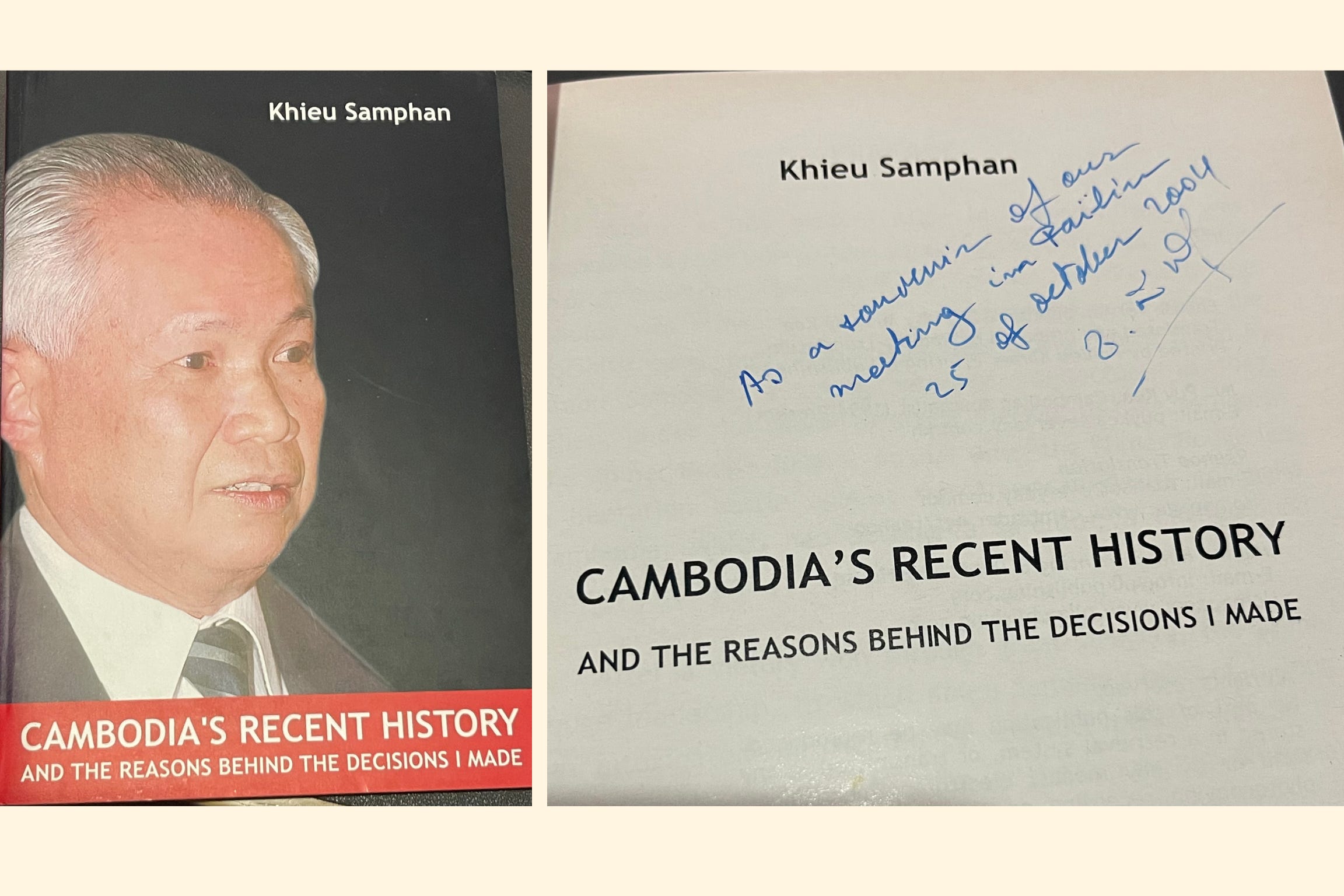
At dinner, he changed dramatically. After realising that we were both fluent French speakers, our conversation quickly turned to descriptive stories of youth spent at university salons and cafés in France. His memories came alive very vividly. But there was a space he never crossed in French; he never spoke of the genocide.
Gaza
That was twenty years ago. Today, the world witnesses another genocide — this time in Gaza, among Palestinians. And unlike Cambodia, the facts and the truth don’t seem destined to emerge intact.
People are risking their lives to document in real time the destruction of the physical, cultural, and human infrastructure that makes up Palestinians life. We see it. We hear it. The language used by some Israeli officials and religious leaders mirrors the genocidal: calls to erase, flatten, destroy. And yet, consensus on the basic facts remains elusive.
Why is that?
Part of this is the geopolitical shielding of a state by its superpower ally. But another part is something new, something more insidious: the erosion of a shared reality itself.
We no longer navigate the same road, see the same signposts, approach the same facts, even see the same reality. Each of us travels a bespoke path carved and curated by algorithms designed to optimise engagement (and profit), not understanding (and peace). Where there were once potholes (distortions, biases, errors) that could be easily filled in during the dry season, there are now sinkholes (no shared reality). Manufactured narratives, AI-generated images and videos, cherry-picked truths, weaponised doubt.
Facts no longer flow toward a common understanding, but rather, they fragment and splinter. Before long, bespoke facts harden into parallel worlds.
The Age of Bespoke Genocide
I wonder if we have we entered into a new age of the bespoke genocide — defined not by the absence of evidence, but by the personalisation of doubt, where mass atrocity is endlessly reframed and contested by machine-augmented and amplified narratives. Where the Khmer Rouge genocide became a fixed point in global memory, Gaza risks becoming a contested simulation, constantly rewritten by those with the most powerful computational tools, crowding out truth and sowing doubt in its place.
Generative AI systems don’t just hallucinate, they absorb the lies, half-truths and synthetic facts of others – then remix and reinforce them. State and non-state actors alike actively engage in LLM grooming — flooding the information ecosystem with synthetic content, manufactured consensus, and hyper-partisan distortion designed to influence how AI models interpret reality. The result? Outputs that blur the line between evidence and ideology, often reinforcing the narratives of the powerful.
Importantly, different rhetorical weapons are deployed to shut down exactly the inquiry necessary to identify the abuse of technological tools and safeguard the integrity of our information ecosystem. The fear of being tagged as “anti-Semitic” becomes a tool of control — one that destroys careers, isolates individuals, and disincentivizes the kind of transparency, research and critical inquiry that preserves the facts for history.
Generative AI systems don’t invent this dynamic, but they are essential tools in amplifying and normalising it. They harden bespoke truths and deliver them to targeted “users” in a tone and aesthetic designed for maximum credibility to sow maximum doubt in the truth. Today we are seeing powerful state actors seeking to reshape the truth in order to prevent an historical reckoning, to retain power and dominance over others.
The Power of Shared Reality
In Cambodia, once the truth emerged — first in drips and drabs, and then in a flood — the pictures and testimonies led us to something solid and reliable: a shared reality, upon which society could take stock, seek accountability, and pursue justice.
The shared reality and shared reckoning make recovery possible.
When facts can be manufactured, truth placed in doubt, and memory made questionable, accountability becomes pretty much impossible. The rhetorical weapons – labels used to silence – decrease our ability to preserve the facts of this history. The same frontier tech tools that could deepen our understanding of the world risk becoming the mechanisms through which the guilty wash their hands of their sins. And perhaps more importantly, deny the accountability and justice victims deserve and societies need to recover and rebuild lives.
The road to Pailin — rutted and broken by the monsoon, yet still repairable — could be navigated because everyone could agree on where the damage was and what it would take to fix it. In much the same way, the shared reality of the Cambodian genocide allowed for reconciliation and, however imperfect, justice.
This is exactly what we risk losing now in the age of bespoke genocide: a common understanding of what is broken, the crimes committed – a shared reality. In other words, we are losing the ability to face the same facts, grieve the same losses, and hold the guilty to account.
Information Disorientation
We need to name what we see and we are experiencing. This misuse of AI tools isn’t just a case of disinformation; it’s a case of disorientation, a strategy to erase atrocity and accountability even as it unfolds. We must acknowledge and understand exactly how AI tools can be exploited, abused and used intentionally to weaken information integrity, and insist on regulatory frameworks that hold developers and deployers accountable for the social harms their systems enable.
Khieu Samphan was eventually tried and rightfully convicted by a UN-backed tribunal. The narrative he attempted to shift in the book he gave me that day did not survive the reckoning.
