


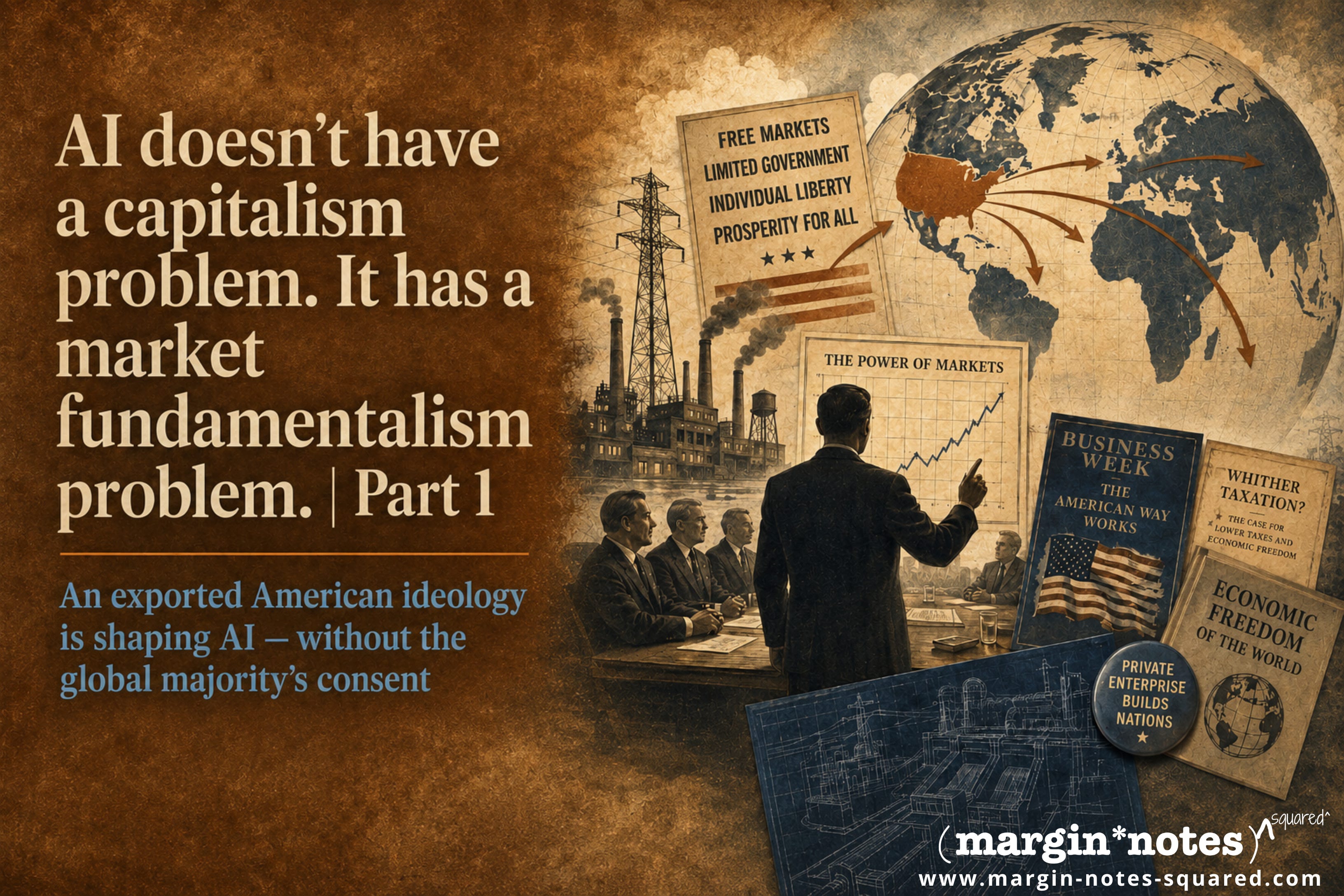
This is the first of a TWO-PART SERIES.
PART 1 traces the genealogy of American neoliberal market fundamentalism — the specific ideology, not “capitalism” in the abstract. This is the framework through which AI is being built, deployed, and governed. It begins with a utility company propaganda campaign in the 1920s and ends with a documented track record of falsehoods and damage.
PART 2, published next week, turns to what this ideology does when it encounters inconvenient voices in the AI moment — how it shapes who sits in the rooms where AI governance is decided, what is discussed and what the people on the margins and the global majority are owed instead.
The question my sister and I couldn’t answer
At some point in the past decade or so, it became normal for government officials across Asia to clear their schedules for visiting tech executives the way a previous generation cleared them for other officials (think government agency heads, ambassadors, even heads of state). These government-tech meetings of course would be neatly packaged up into digital soundbites, enveloped in bilateral courtesies and carefully managed optics with the principals standing side-by-side, as if a meeting of two equals on Urgent Matters of mutual interest had just finished.
The thing is: they’re not equals and never have been.
The big tech executive arrives with a business model, a polished narrative, and a desire to grow and make big profits, to accumulate market power (and increasingly, “policy” or political power, too). The minister has the interests of her people — their welfare, safety and thriving — top of mind. The executive gives unsolicited advice, promises investments (in people or bricks — but just enough for the headlines), and warns against anything that might inhibit growth and the magic of tech. The minister receives, and hopes something good comes of it.
I’ve been on both sides of this story — something I’ll come back to. But that’s not where this all starts.
It starts with a recent question my sister and I tossed around and couldn’t answer. After my surgery in Germany — which I wrote about in another piece here — we got talking about why Americans are so viscerally allergic to government health insurance, or socialised medicine. Somewhere along the way, generations had been taught that socialism equals communism equals totalitarianism, and that was that. Big business is good; big government is bad. It was just true. (President Bill Clinton, a Democrat, even famously declared in 1996 that “the era of big government is over.”) We couldn’t explain how it had happened.
That vexing question nagged at me. Poking around, I found an article and a book that helped make things clearer — and connect the dots to what's happening in tech today.
The capitalism problem
Last weekend, I read a piece from Nathan Sanders and Bruce Schneier, both Fellows at the Berkman Klein Center for Internet & Society at Harvard University. Their essay in Tech Policy Press — Separating AI’s Technological Problems From its Capitalism Problems — is sharp, necessary and correct as far as they take it. Read it.
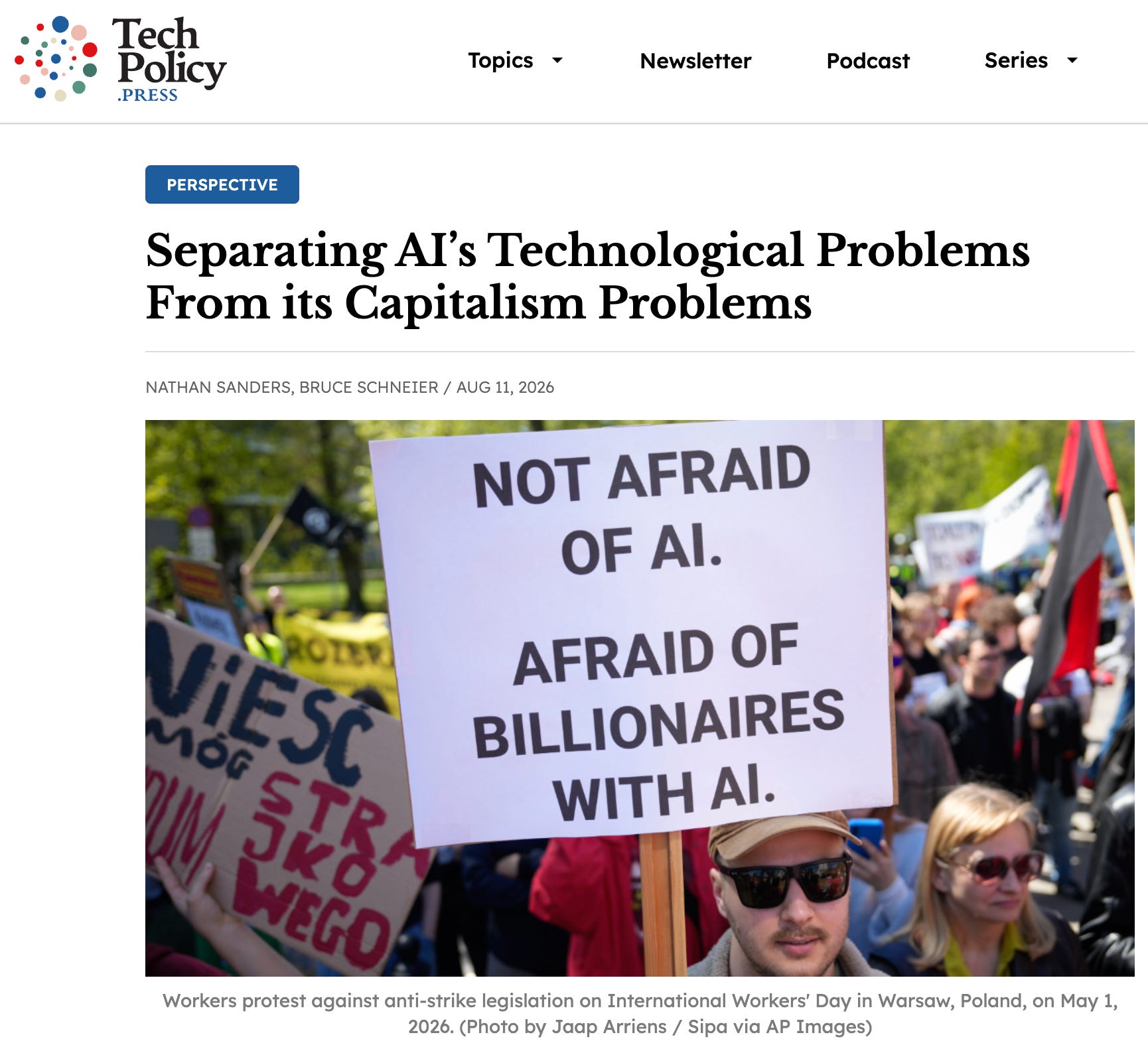
But I don’t think it goes far enough. What they miss in that article is what I think may be the most consequential blind spot in our current understanding of our AI moment.
Sanders and Schneier correctly argue that AI’s most serious problems are not technological but structural — products of the economic and social systems in which the technology is embedded. It’s the capitalism. This is definitely the right way to look at it.
But “capitalism” really runs the gamut, and they don’t define which capitalism they’re talking about. Left undefined, it’s too broad, and ultimately too neutral, to inform how we investigate today’s challenges with tech. Capitalism takes many forms, from unfettered and dogmatic “free markets” to social democracy and regulated markets to mixed economies — the full range under which markets have operated with varying degrees of equity and accountability. (Never mind that purely “free” markets do not exist, as much as libertarians would like to believe otherwise.)
Left undefined, capitalism also fails to explain the specific political construction of economics that is actually at work. At play today is one that was manufactured over decades through deliberate ideological investment, and eventually exported to the world through the Washington Consensus and the conditionalities of the IFIs the Americans greatly influence.
This construction has done three things consistently. It has bolstered the power of the wealthy and exacerbated inequality. It has allowed money to fabricate narrative. And it has permitted industry to externalise its costs onto workers, communities and the global majority — all while internalising profits for shareholders.
Milton Friedman would be proud.
To be clear, this is a decidedly American political construction exported globally (through sheer force of will and a dash of military might), not an economic system.
We need to name what we are actually dealing with – specifically. It is not capitalism in the abstract or general sense. It is American neoliberal market fundamentalism — a specific ideology, constructed by specific people over eight decades, with a traceable genealogy and a documented track record. Until we acknowledge this, we will keep treating symptoms while the underlying political architecture goes untouched.
Understanding that genealogy is both an exercise in history and a precondition for knowing what we are up against so that we can most effectively build strategies against AI power accumulation, harms and inequalities.
American neoliberal market fundamentalism, defined:
A manufactured ideology, built over eight decades by identifiable people and organisations with identifiable interests, that has shaped perceptions around what counts as legitimate governance and what is naïve interference with “the free market”
The Big Myth
Also this week, I turned the last page on Naomi Oreskes and Erik Conway’s The Big Myth: How American Business Taught Us to Loathe Government and Love the Free Market. Across 431 pages of historical analysis the pattern appeared: a clear genealogy of why America’s capitalism is not just problematic, but founded on a dangerous myth, one that once ingrained within America itself has been exported to the rest of the world for decades. I finally had a direct view into how we got here. (It’s such a good book, I read it in four days!)
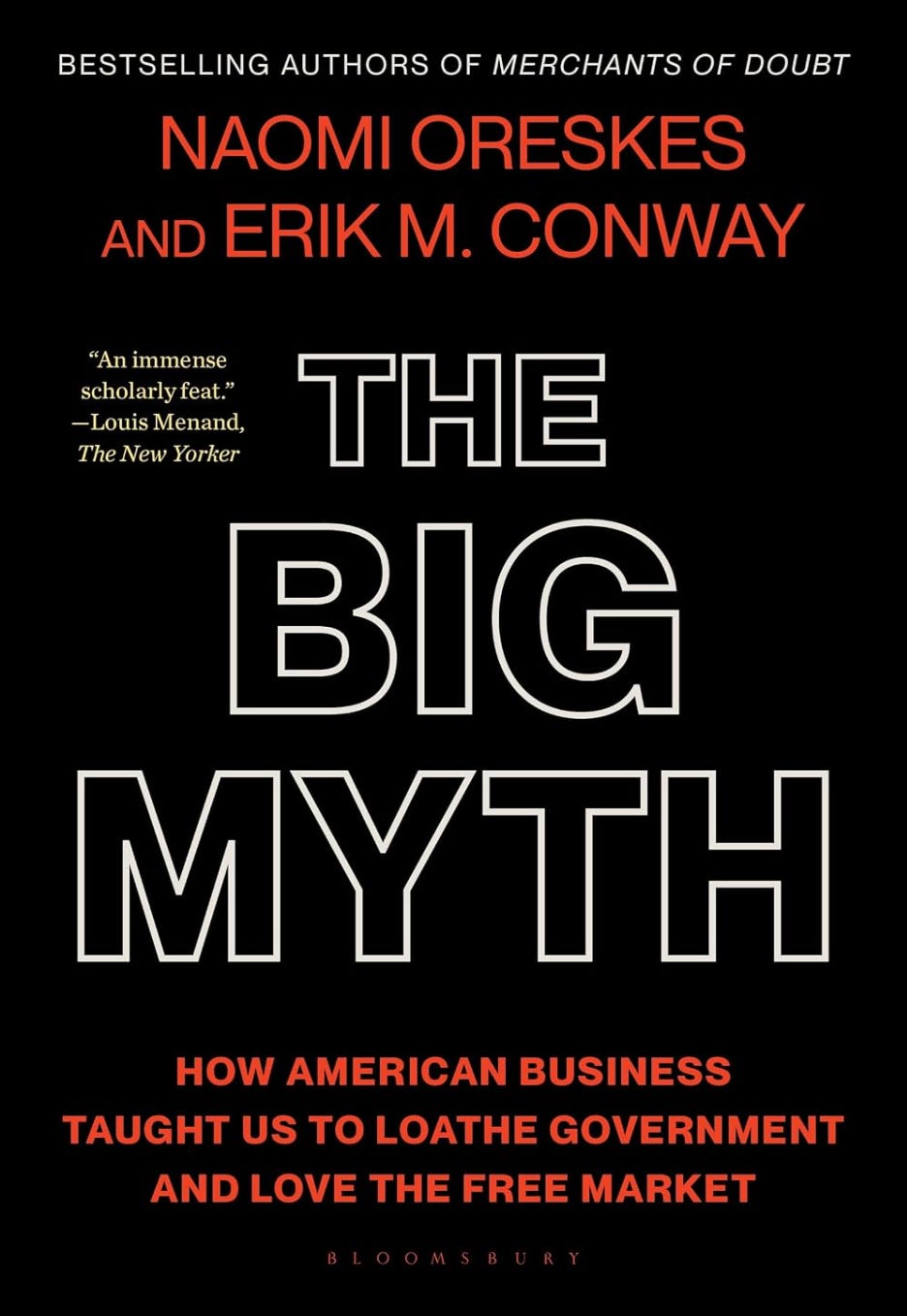
One of the most important things Oreskes and Conway demonstrate is that it isn’t even sound economics — it was built on axioms, not laws. The “economic science” of the Austrian Friedrich Hayek, popularised by the American Milton Friedman and mainstreamed by the Chicago School, operated as pure dogma: non-falsifiable claims, without need of being tested, treated as foundational. Eventually, questioning it became not only intellectually difficult but a social (and even religious!) transgression. And politically dangerous.
Their book documents how American business systematically manufactured the ideology of market fundamentalism over the course of the twentieth century. I use the word “manufactured” deliberately: this was not an intellectual tradition that emerged organically, was tested against evidence and prevailed on its merits. It was a propaganda project — funded, organised and sustained by business associations (and companies — hello, GE!) whose long-term interest in the outcome was direct and material.
The story begins with electricity, which feels fitting: the same battle over who controls essential infrastructure is now playing out with AI data centers straining the grid. The National Electric Lighting Association (NELA), representing private utility companies, faced a problem in the 1920s: the public was beginning to ask whether or not utilities should be publicly owned, especially in order to extend the grid to rural citizens. Despite the Ontario public grid just across the border electrifying more rural geographies at a cheaper price compared to American counterparts (not to mention the great advances Europe was making in electrification, also far more equitably and cost effectively), NELA’s response was to fund a long-view campaign — in schools, in newspapers, in civic organisations — to associate private enterprise with freedom and government provision with tyranny. Not to make a case for utilities specifically, but to reshape the ideological environment within which all such questions would be asked.
They invested in this because the public was not on their side. Early in the twentieth century, most Americans were deeply suspicious of big business and saw bigger government as their ally. That had to change — and they set about changing it.
NELA died a sudden death – after a federal investigation exposed their aggressive (and often stealthy) propaganda campaign against public and municipal power ownership. But the National Association of Manufacturers (NAM) took up their project and took it further (yes, the same NAM that opposed child labour laws, claiming it was socialist!), systematically opposing FDR’s New Deal on the grounds that government intervention in the economy was incompatible fundamentally with American liberty itself. That dogma — borrowed and developed from the Austrian economists Friedrich Hayek and Ludwig von Mises, whom American businessmen helped bring to prominence in America — was to bundle civil and religious liberty, representative democracy, and free private enterprise.
Thus economic freedom, political freedom and moral freedom became a single inseparable package, the propaganda metaphor of the “Tripod of Freedom”: allow the government to regulate the market, and we are setting ourselves on the road to totalitarianism and atheism. Any challenge to economic freedom was, by definition, a challenge to all freedom. Hence Hayek’s Road to Serfdom was disseminated far and wide with NAM financing. (To this day it remains a go-to text for “free-market” think tanks and libertarians.)
But Hayek was a bit too intellectual for the mainstream. What the business coalition needed was someone who could translate the axioms into accessible, authoritative economics. Milton Friedman was that person. He wasn’t on NAM’s payroll, but he was never far from their money — corporate interests and wealthy industrialists financed the university programmes, foundations and lecture circuits that built his platform and amplified his ideas. He academicised the construction into what became the Chicago School, and on 13 September 1970 published his famous New York Times essay “The Social Responsibility of Business is to Increase Its Profits.” Not to serve communities. Not to sustain the conditions of human flourishing. To increase profits. Full stop.
Ronald Reagan made it emotionally available to ordinary Americans. What fewer people know is that Reagan went into his career as a New Deal Democrat and emerged as a market fundamentalist — not through intellectual conversion, but through a deliberate corporate education programme run by General Electric, whose television propaganda show (in the service of The Tripod of Freedom) he hosted for eight years. GE not only rescued Reagan’s acting career, but they also put him in front of plant workers and executives across the country, refined his message, and produced, at the end of the process, the political voice that would carry the ideology into the White House and from there into the operating systems of international institutions for the next four decades.
This was not capitalism au naturel. This was a political project that spanned eight decades, and it survived by suppressing every voice that would have encouraged and required it to change course.
Clinton’s declaration back in 1996, about the era of big government being over, is revealing. That was in his State of the Union address, and to be fair, he added a hedge: "The era of big government is over. But we cannot go back to the time when our citizens were left to fend for themselves." That hedge is the real tell. It is the language of a politician who has already conceded the framing ideology and is just trying to salvage something at the margins. When the opposition can only argue for a slightly smaller retreat, the ideology has won.
The Tripod of Freedom
The Tripod of Freedom was much more than just a propaganda slogan; it became a determining worldview with predictable consequences. Once economic freedom becomes inseparable from all freedom, regulation becomes tyranny, big government becomes the enemy of liberty, and the state’s role shrinks to enabling business rather than protecting people and enabling human flourishing. Far from being accidental outcomes, these are the results of a plan that delivered as promised.
In practice, the Tripod produced a set of recognisable conditions, some of which are worth summarising here:
Externalities become someone else’s problem. The market internalises the profits and externalises the costs onto workers, communities and the environment. Industry keeps the gains while everyone else absorbs the damage.
The state exists to serve the market, not to ensure the market serves people. Deregulation, tax cuts and public-private partnerships are not pragmatic compromises but are instead expressions of a governing philosophy in which the government’s legitimate (and de minimis) role is to enable business, not protect citizens.
Narrative follows money. Whoever funds the think tanks, university chairs, media presence, research, analysis and political access shapes what is seen as Serious Policy and consequently what gets dismissed with a wave of the hand as naïve interference, or at worst, as socialism or communism. The ideology sustains itself by controlling what seems thinkable.
Short-termism becomes a virtue. Quarterly returns, VC exit timelines, the race to scale before regulation catches up — all systematically disadvantage long-term public goods like climate, health and equity (and now frontier tech like AI), which don’t fit inside a quarterly earnings call.
Business(men) know best — and deserve their rewards. Wealth becomes evidence of superior judgment. The rich are rich because they earned it; the poor are poor because they didn’t. Therefore, inequality is proof that the system is working.
If this piece opened up something you hadn't quite seen before, consider passing it on to someone who's thinking about where AI, power and the global majority are heading. Word of mouth is still how most readers find (margin*notes)^squared — and every share matters.
America’s capitalism
Built on emotion and ideology rather than robust evidence, neoliberal market fundamentalism made an easy promise: free the market from all government interference and prosperity will flow outward naturally. Business executives must be allowed to work their magic, to raise all boats, to benefit all Americans. The United States ran this experiment from 1980 onward. It was called trickle down economics by Reagan. He even called it magic.
But it was, and is, bunk.
The results are documented. The top one percent now holds more wealth than the entire American middle class. Real wages for most workers have stagnated for four decades. The social infrastructure — healthcare, education, housing — has been hollowed out in exact proportion to the degree this free market logic was applied to it. And the environment: the same tradition, the same ideology, the same actors who assured us that markets would solve the climate crisis, have presided over forty years of accumulating catastrophe while the window for meaningful action closes.
Markets did not fix climate change. Markets have not fixed healthcare in America. Markets have not fixed inequality. Yet, America’s markets have become the world’s markets.
And the same business voices are now telling us they will make sure AI benefits everyone, that too much regulation will inhibit their innovations — which we apparently so very much need.
This is not a prediction. It is a pattern from the historical record.
The pattern is important to unpack because it is repeating – this time with artificial intelligence. Part 2 picks up there next week.
Most frontier tech commentary and analysis comes from one perspective. Mine doesn't. I've spent decades inside government and diplomacy, inside big tech and inside civil society — across Southeast Asia and APAC. (margin*notes)^squared is where I bring all three to bear on the political economy of AI, from the perspective of people on the margins, rooted in human rights and flourishing.
Subscribe for analysis that starts from somewhere different.