

Cracking the Silicon Bloc (Part 1)
From Solidarność to Silicon: A Political Story

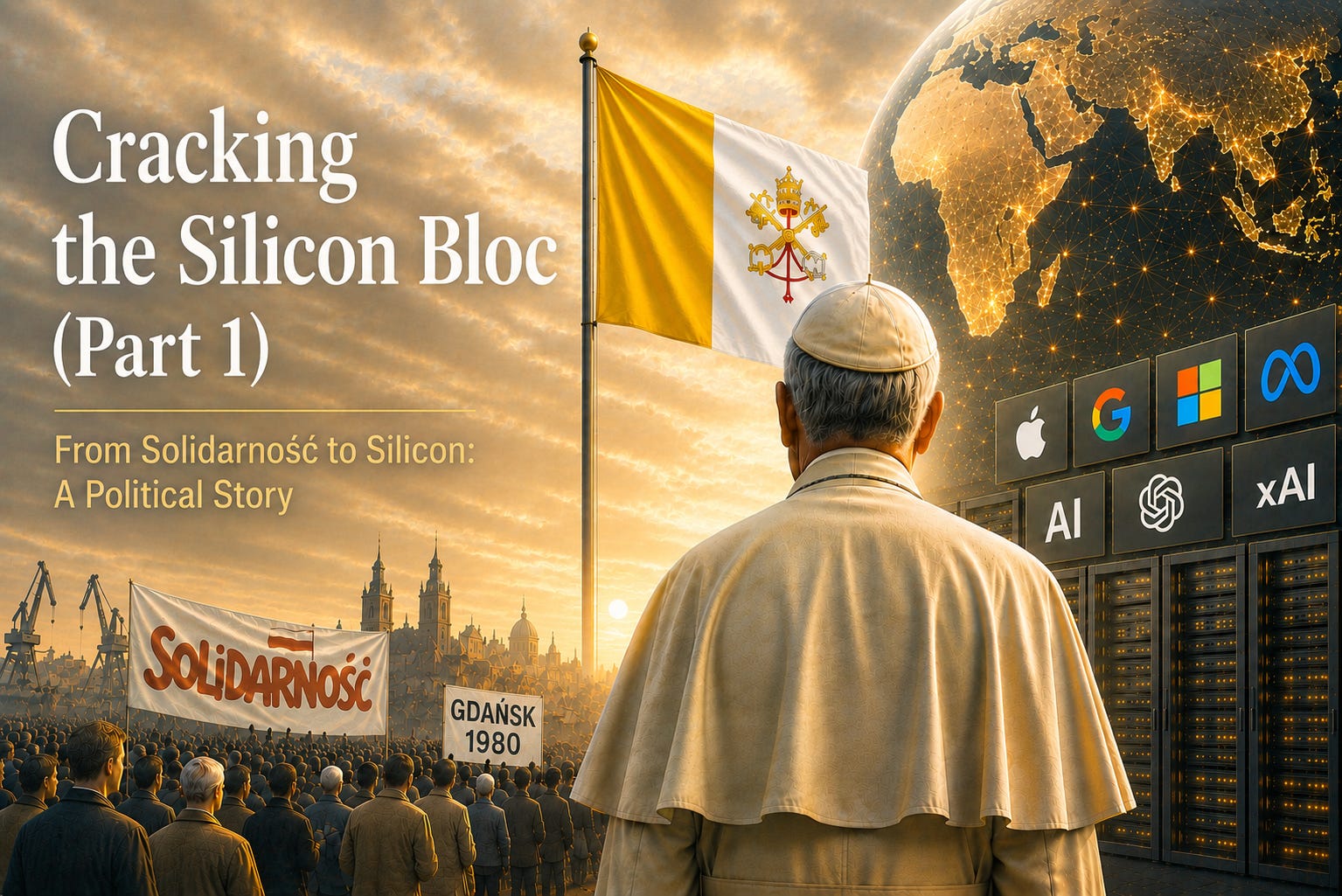
I poured through the Pope’s recent encyclical, Magnifica Humanitas, and last week I published my thoughts on that: Pope Leo XIV’s Guide to Disarming Technocolonialism. In that article, I suggested that the Global South may have just gained their most substantive ally in the struggle for just, equitable and human-centred AI governance, and I ended that piece with this:
“John Paul II inspired Solidarność — giving ordinary people the courage to demand basic human rights under communist oppression, creating cracks in the Soviet bloc. I think Leo XIV is doing something analogous: inspiring a different kind of solidarity movement, giving it the moral vocabulary to demand digital rights and human agency under extractive capitalism, creating cracks in the Silicon bloc.”
That analogy deserves to be taken seriously — which I quickly realised meant interrogating it a bit.
This is the first of a 2-part series that tries to do exactly that:
Part 1, today, examines what John Paul II did: not the saintly version, but the political-tactical one — how he built vocabulary, infrastructure and coalition into a force that an adversary could not suppress.
Part 2, next week, dives into the harder question: given that Leo XIV has no Reagan, no Cold War and no Solidarność waiting in the wings, what could it actually look like to run a similarly inspired playbook today?
What can history teach us?
Political Equations
Magnifica Humanitas is a document about power — specifically technocolonialism, and the Church as an unlikely but structurally significant ally for the Global South in AI governance. In last week’s piece I shared a personal memory: thirteen-year-old me on a Detroit street in 1987, waving a Vatican flag as Pope John Paul II rolled slowly past in his popemobile. I didn’t realise it then, but JPII was at the height of his political-moral authority, having inspired Solidarność, the Polish trade union, and having helped crack the authoritarianism of the Soviet bloc.
I wondered, can Pope Leo do something similar for technocolonialism, to crack the Silicon Bloc?
While last week’s piece was about the moral and philosophical argument, this week I want to examine the political one — because JPII’s power didn’t come from moral authority alone, and Leo XIV’s won’t either.
Context matters. You see, JPII’s moral authority aligned with the geopolitical interests of the most influential democracy of the time, Reagan’s America. As a political economist, the question that interests me is not what JPII said per se, but how he made it stick. What coalition formed, encouraged and strengthened by that moral authority, to give it tangible political and policy force? And the answer, it turns out, involves fax machines, the CIA, structure and a great deal of unglamorous organisational work.
As a political economist, the question that interests me is not what JPII said per se, but how he made it stick. What coalition formed around that moral authority to give it tangible political and policy force?
Carl Bernstein’s landmark 1992 investigative report in Time magazine documented what he called a Holy Alliance between America’s then President Ronald Reagan and Pope John Paul II, the Vatican’s Head of State. They and agencies under their control coordinated specifically to sustain and strengthen the Solidarność labour union and what became a pro-democracy movement against the authoritarian Polish communist regime.
Reagan’s National Security Adviser described it as “one of the great secret alliances of all time.” A U.S. official quoted by Bernstein was characteristically blunt: “Like all great and lucky leaders, the Pope and the President exploited the forces of history to their own ends.” The CIA provided material support — printing equipment, fax machines, communications technology — channelled into Poland through Church networks. The Vatican provided the moral cover, the physical and organisational infrastructure, and the popular legitimacy that is difficult to simply manufacture.
Leo XIV’s challenge today is genuinely inverted. JPII’s adversary was a foreign power (the Polish communist regime, and by extension, the Soviet Union) operating from outside the Western democratic system. Leo XIV’s adversary is a creature of domestic American capitalism operating from inside it — making the dominant superpower not an ally to be recruited but part of the problem to be navigated. JPII could move toward Washington; Leo XIV cannot. Further, JPII had the world’s democratic superpower patron absorbing geopolitical risk on his behalf. Leo XIV has no equivalent — and the U.S. government is compromised by its unhealthy relationship with the Silicon bloc. So the coalition has to be built differently.
A full accounting of the Silicon bloc would also reckon with China — its state-backed AI champions, its export of surveillance infrastructure and its own form of techno-authoritarianism. That is a serious topic deserving its own treatment, and I’ll leave that to others for now. This piece focuses on the democratic half of the bloc, where the JPII comparison is most direct and where Leo XIV’s institutional leverage is greatest.
Today, there is no Reagan waiting to show up at the Vatican to talk strategy.
Saint and Strategist
It’s tempting to focus purely on John Paul II’s moral authority in cracking the Soviet bloc, but that would deliberately paper over important complexities and present an overly lionised version of him. That wouldn’t serve well the purpose of learning from history to serve the needs of humanity today.
So let’s spend some time thinking about the political-tactical version of JPII’s efforts, specifically how he:
Gave people a shared vocabulary that was harder to suppress than political language;
Used the Church’s physical infrastructure strategically; made Solidarność internationally legible; and crucially,
Told people their fear was the regime’s most powerful weapon. “Don’t be afraid” was a political act, not just a spiritual one.
The vocabulary
John Paul II was less than eight months into his Papacy when he made his first pilgrimage to Poland, his motherland, and delivered a homily to hundreds of thousands of people at a mass held at Warsaw’s Victory Square (now Piłsudski Square).
When he spoke of “dignity and rights,” the communist authorities faced an impossible problem: suppressing Catholic moral language would mean suppressing Catholicism itself. But JPII was doing something tactical. He spoke directly into the language of the Helsinki Accords, signed just four years earlier in 1975, in which the Soviets had formally committed to respecting human rights and fundamental freedoms. By nuancing that secular framework with his own moral arguments, he effectively weaponised the regime’s own signature against it. Challenging him meant challenging not only a document the Soviets had publicly endorsed, but even closer to home, also challenging Catholicism straight on.
His early homilies never pointedly called for political revolution, but his language was revolutionary. He ended that sermon at Victory Square, for example, with these words: “Niech zstąpi Duch Twój! Niech zstąpi Duch Twój! I odnowi oblicze ziemi. Tej Ziemi!” (English: “Let your Spirit descend. Let your Spirit descend. And renew the face of the earth, the face of this land.”)
Note how in the Polish, ziemia was used for both “earth” and “land”. It was clear that he was calling for the renewal of Polish land, of Poland itself. In a regime that claimed to speak for the Polish people, a Polish Pope returning home drawing an estimated ten million people — roughly one in three Poles — to his Masses and public appearances across the country, the psychological effect was irreversible: city after city, the regime watched enormous crowds assemble peacefully outside its control, which was itself the demonstration.
But moral authority and legal cover alone don’t crack a the Soviet bloc. That required Reagan’s America absorbing the geopolitical risk that neither the Church nor Helsinki could provide alone. And as history shows, the regime first cracked down, then negotiated, then yielded to the forces of solidarity, in every sense of the word.
The infrastructure
General Jaruzelski declared martial law on 13 December 1981 and had more than 3,000 Solidarność leaders and members arrested overnight, with thousands more detained in the days and weeks that followed. Solidarność went underground. But the Church was there waiting.
Church basements became meeting rooms. Priests became couriers, moving messages between cells. Rectories became safe houses for leaders in hiding. American-funded printing presses, fax machines, transmitters and computers moved clandestinely into Poland through Church channels, often packed in mismarked shipping containers unloaded by sympathetic dockworkers in Gdańsk. Catholic clergy, laypersons across and the budding human rights community across Western Europe kept the flow of information and resources uninterrupted.
The network extended well beyond Poland’s borders through sympathetic clergy and the Vatican’s own diplomatic apparatus across Europe, according to subsequent historical accounts of the period. Polish émigré communities, often organised through parish networks, kept the pressure on Western governments and media. The Vatican’s own diplomatic apparatus worked the corridors of international institutions. It was an international operation, held together not by a command structure but by a shared institutional identity, emotional and political commitment to the rights of human beings, that crossed borders the Cold War had otherwise sealed.
In Poland, the communist state’s fatal weakness was that it could never control the one institution that commanded deeper loyalty than the Party. The Silicon bloc has an equivalent blind spot: its infrastructure extracts from communities it does not inhabit, monetises relationships it did not build and governs the digital lives of populations whose trust it has never earned. The Church, by contrast, has been in those communities for generations — not as a platform but as a presence, which is not nothing. Which is, in fact, incredibly powerful.
This is the structural advantage Leo XIV still has today.
International legibility
Before John Paul II, Solidarność was simply a trade union engaged in troublesome labour disputes on behalf of Polish dockworkers. After him, it was a global moral cause.
In his October 1979 speech to the United Nations General Assembly, JPII framed human rights in universal terms that resonated far beyond purely Catholic catechism. He enumerated rights spanning civil, political, economic, social and cultural dimensions, insisting they must be held together as an indivisible whole, and drew a direct causal line between rights violations and war: “the spirit of war springs up and grows to maturity where the inalienable rights of man are violated.” Grounding his argument in plain moral language in a vocabulary that spoke across faith traditions and required no fluency in theology to understand, he issued a universal challenge to any system — of any ideological character — that reduced the human person to a single dimension or subordinated rights to political interests.
Western labor movements — including the AFL-CIO — channelled support to Solidarność partly because the Pope had given it moral legitimacy that transcended Cold War politics. When he traveled again to Poland in 1983, at the height of martial law repression, the global media followed him. The regime could arrest union organisers. It could not arrest a story being watched by the world. John Paul II made the struggle of Solidarność legible to audiences everywhere who might otherwise have seen it as an internal Soviet-bloc affair.
This didn't happen in a vacuum. The 1970s and 1980s saw a remarkable flowering of global civil society around human rights — Amnesty International won the Nobel Peace Prize in 1977, the Helsinki Accords of 1975 had (in)advertently legitimised human rights monitoring behind the Iron Curtain (and the creation of Helsinki Watch, now Human Rights Watch, in 1978) and a generation of activists, lawyers and journalists had built the infrastructure of international human rights accountability that gave Solidarność's struggle a prepped global audience. JPII didn't create that environment. He stepped into it at precisely the right moment — and gave it a moral vocabulary and an organisational base that civil society alone could not have provided.
In that 1979 UN speech, JPII certainly had hot wars in mind — the Soviet tanks that had rolled into Budapest in 1956 and Prague in 1968 were living memory, and the threat of military escalation was the ever-present backdrop to everything Solidarność did. The causal chain from rights violations to war was, for his audience, not abstract at all.
Leo XIV faces a different threat landscape. The conflicts that matter now rarely involve formal declarations of war: they are fought in submarine cables and server farms, in export controls on semiconductors and in the race to dominate frontier AI development before the other side does. Washington and Beijing are locked in what many are calling a new cold war — but one whose terrain is algorithmic, whose weapons are models and chips, and whose casualties are often the communities in the Global South caught between two technology superpowers neither of whom asked for their consent. He faces a Silicon bloc whose power doesn’t require an army because it is already inside the infrastructure.
Making that conflict internationally legible — and making the human cost of it morally unavoidable — is Leo XIV’s equivalent task.
“Don’t be afraid”
The regime’s deepest weapon was not tanks — it was the belief that resistance was futile and that you were alone. JPII demolished both these notions in a single visit. When he returned to Poland for the second time in 1983 at the height of martial law and again drew millions to see him, the psychological effect was clear. People who had lived under the atomising pressure of a surveillance state suddenly discovered they were not a minority. They were the majority, and they had always been.
“Don’t be afraid” was not a reassurance, but rather a diagnosis: the regime runs on your fear. Just stop supplying it.
Historian Timothy Garton Ash famously summarised the chain reaction of the Pope’s 1979 pilgrimage to Poland with this: “Without the Pope, no Solidarity. Without Solidarity, no Gorbachev. Without Gorbachev, no fall of Communism.”
The chain reaction Garton Ash describes took a decade to run through. It required vocabulary, infrastructure, international legibility and the courage to name fear as the regime’s primary weapon. None of it was inevitable. All of it was built.
The project for Leo XIV is whether an analogous chain is possible in the digital age — and what it would look like to start building it. The Silicon bloc does not rule by tanks or surveillance checkpoints. It wields power by convenience, dependency and the smooth normalisation of constant extraction. Its strongest weapon is not repression but resignation: the belief that the architecture of digital life is simply how things are, that the concentration of AI power in a handful of companies is a fact of nature rather than a political choice, and that there is no majority waiting to discover itself.
“Don’t be afraid” was JPII’s diagnosis for Poland. Leo XIV’s equivalent — buried in Magnifica Humanitas — may be this: the terms of the digital order are not written in stone. The trajectory of technology is not inevitable. The policies that will bend that trajectory toward human welfare, flourishing and the good life are being written now. And the people who bear the costs of that order are more numerous than those who profit from it. They always have been.
The trajectory of technology is not inevitable.
What JPII Built
The Garton Ash chain — no Pope, no Solidarity, no Gorbachev, no fall of Communism — risks making it all sound inevitable in retrospect. But it wasn’t.
What John Paul II did was neither miraculous nor accidental. It was a coalition: moral vocabulary that couldn’t be suppressed without suppressing religion itself; physical infrastructure the state could not colonise; international legibility that turned a Polish labour dispute into a cause for freedom that resonated internationally; and a psychological intervention that named fear as the regime’s primary weapon and invited people to stop supplying it. Underneath all of it was the unglamorous machinery of the Holy Alliance — the fax machines, the shipping containers, the émigré networks, the CIA. And the emerging human rights community bolstered by Helsinki.
The analogy with Leo XIV is not perfect — no historical analogy ever is. But I believe the structural logic holds: moral authority alone does not move geopolitical mountains. It moves them when it is organised, resourced and connected to actors willing to absorb risk on behalf of a shared interest.
JPII had all three: the moral authority, the organisational infrastructure, and a coalition partner willing to absorb geopolitical risk on behalf of a shared interest. Leo XIV has the first. Whether he develops the second and builds the third is the question this series explores.
Next week, Part 2 turns to the harder problem. Leo XIV has no Reagan and no Cold War adversary whose defeat serves a superpower's interests. Unlike JPII, he does have a vast global civil society already working on AI governance, digital rights and technocolonialism — in many ways more sophisticated and numerous than anything that existed in 1980s Poland or indeed more broadly internationally. What he doesn't yet have is a Solidarność: a single focal point capable of turning dispersed advocacy into a mass movement with the moral clarity and political force to make the powerful genuinely uncomfortable. The adversary is not a foreign tyranny but a creature of American capitalism — embedded in the infrastructure of everyday life and more influential in Washington than the Vatican is.
As we’ll see, this new playbook has to be written from the coalition upward. What that looks like — in what form Leo’s Reagan might appear, what the fax machines of AI governance are, and where the network that needs to exist is — is where we go next.
Part 2 published next week.
Excellent piece! Your distinction between John Paul II's external adversary and Leo XIV's internal one is a genuinely useful way of thinking about the current moment. It reframes the challenge from confronting a hostile state to navigating systems of power that are embedded in everyday life.
I'm particularly curious where you'll take the Solidarność analogy. If there is no equivalent today, what becomes the organizing force capable of translating dispersed concern into collective action?
Looking forward to Part 2. Your Substack has quickly become one of the few publications I make a point of reading because the analysis consistently goes beyond the obvious.