

Pope Leo XIV's Guide to Disarming Technocolonialism
How the Catholic Church Just Became the Global South's Most Powerful Ally in AI Governance

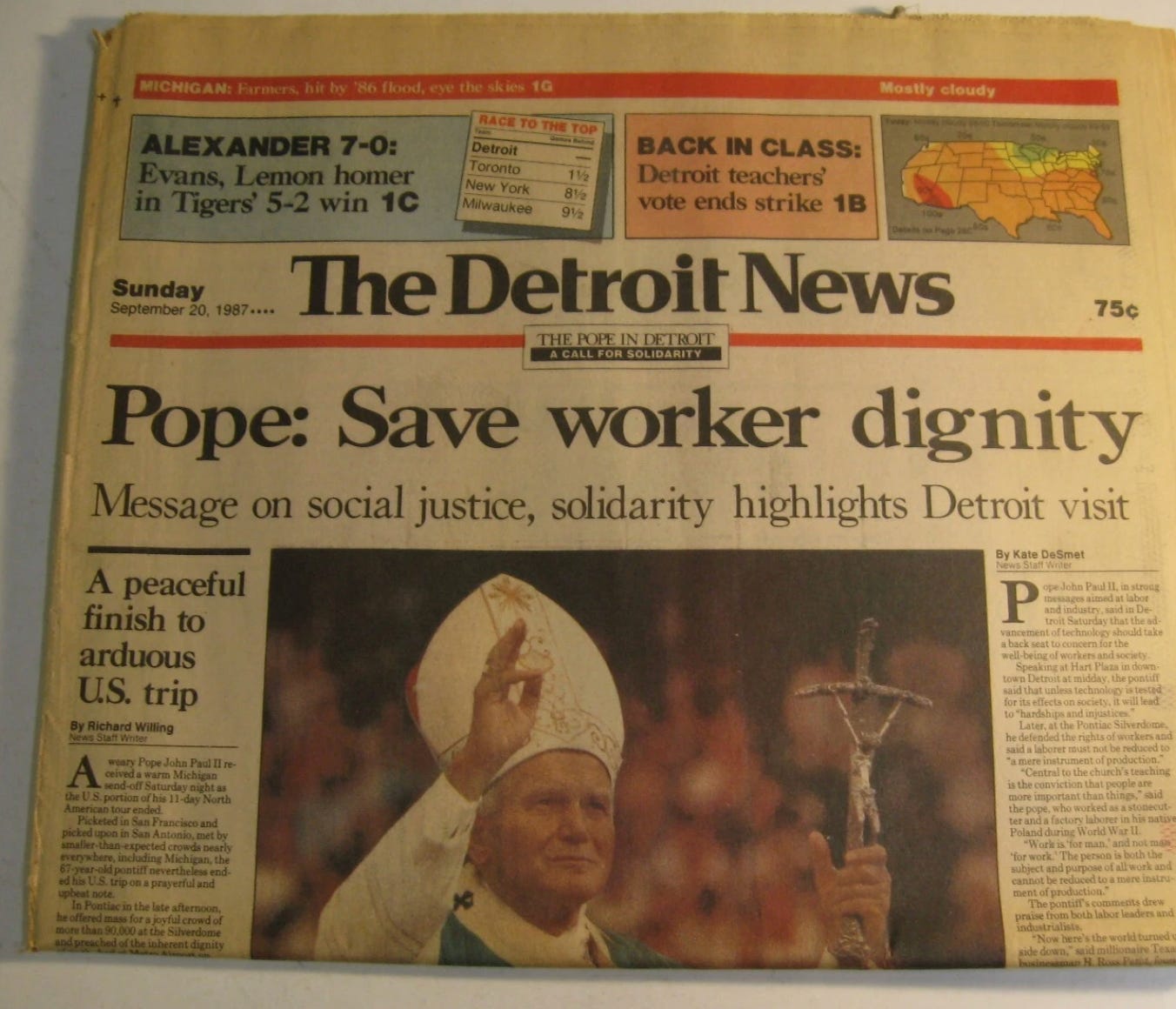
Detroit, 1987
Thirteen year old me held a yellow and white Vatican City flag somewhere in the metro Detroit area, probably Hamtramck, the Polish enclave surrounded by the City of Detroit (now home to the most delightful hybrid Polish-West Asian food, though back then decidedly Polish through and through). The Polish Pope was coming to Detroit, and there was no way that this Polish family wouldn’t be there for him, waving the papal banner. I remember this distinctly because it was the first time I encountered a square rather than rectangular flag (how odd, I thought, but it subsequently ignited a lifelong obsession with flags – the most interesting one, of course, is Nepal).
Then I saw him.
Pope John Paul II (né Karol Józef Wojtyła) in his Popemobile. In the flesh. (There have maybe been only three times in my life when I’d been in the presence of such human awe and when to this day I still get goose bumps thinking about the experiences: John Paul II, Nelson Mandela and the Dalai Lama.) John Paul was at the height of his moral-political authority, having inspired 1980s Solidarność (Solidarity) labour movement, giving Polish workers the courage to demand basic human rights under communist oppression, creating cracks in the Soviet bloc. (So powerful an influence was John Paul II that Lech Wałęsa’s Solidarność union members hung large portraits of the Pope at the entrance gates to the Lenin Shipyards in Gdańsk, where the union was born.) This is one of those childhood memories that doesn’t seem to mean much at the time, until it suddenly does.
Nearly 40 years later, I have a new life in Asia and there is a new Pope – Leo XIV, an American, the flipside of my identity – who issues an encyclical on artificial intelligence that reads in many places like post-colonial scholarship. Something that I’ve been rather passionate about in these pages. John Paul II electrified the Gdańsk shipyard workers and indeed an entire nation. Thirteen year old me would have never thought another Pope would chart a similar path — this time to confront not communist oppression, but a new kind of colonialism altogether.
This isn’t an article about faith. It is one about power and technocolonialism.
Magnificent Humanity
Magnifica Humanitas is, above all, a document about power — though most mainstream coverage treated it as a document about ethics. It is also the most significant statement on the governance of frontier technology that any faith institution, anywhere in the world, has yet produced. And it is considerably more radical than it first appears.
What makes it remarkable isn’t the theology. It’s what the theology is actually saying. And, perhaps, who was in the room when it was brought to life.
The encyclical was presented at the Vatican’s Aula del Sinodo (Synod Hall) — quite literally the heart of Church governance — with Chris Olah, Anthropic’s Canadian co-founder and current Head of AI Interpretability as a speaker. Olah was raised evangelical and has been an atheist since the age of fifteen. He is also a Thiel Fellow — yes, that Thiel. His presence correctly raised eyebrows.
This was not a quirky invitation. The Vatican’s intelligence and diplomatic apparatus is sophisticated; Pope Leo would have been fully briefed on Olah and Anthropic before any decision to associate at such a level was made. A Pope who has shown no reluctance to sharply criticize Donald Trump or Israel’s violence doesn’t stumble into optics by accident. The Undersecretary of the Dicastery for Culture and Education at the Holy See, Antonio Spadaro called it the “venerable tradition of papal diplomacy – engagement with the uncomfortable interlocutor.”
Anthropic, for its part, would have had its lawyers, communications leads, and policy teams working through every angle of having a co-founder on that stage. So: was this the Vatican playing big tech, or big tech playing the Vatican? I genuinely don’t know — and I suspect many Really Smart People will (excuse the pun) pontificate at length on the question.
What I can say is this: Olah’s own remarks at the launch were not self-serving. He called for something his industry has systematically resisted — external accountability from voices that can’t be bought:
“We need more of the world — religious communities, civil society, scholars, governments, and indeed all people of good will — to do what His Holiness has done here: to take this seriously, to look closely, and to push events in a better direction. We need informed critics who will tell the labs when we are failing. We need moral voices that the incentives cannot bend.”
But that’s only half of the opening story.
Pope Leo also invited a Congolese nun, Sr. Léocadie Lushombo, a theology professor at Santa Clara’s Jesuit School of Theology, to speak in the Aula del Sinodo as well. Her message was direct: “AI can very easily be colonial.”
"[Artificial intelligence] will make those cultures even more vulnerable to colonial extractivism. For this reason, I emphasize Pope Leo's claim that 'Even today, colonialism assumes new forms. It no longer dominates only bodies, but appropriates data, transforming personal lives into exploitable information.' (MH178) Yes, AI can very easily be colonial." — Sr. Léocadie Lushombo, 25 May 2026, Commentary at the Vatican’s Aula del Sinodo
The Pope chose an atheist Thiel Fellow from a frontier AI lab AND an African woman theologian. Olah’s remarks were either a genuine reckoning or an extraordinarily well-crafted piece of reputational management. Possibly both. The optics of the most self-described “safety-conscious” frontier AI lab standing alongside the Pope while continuing to accelerate development (its Mythos and Claude Fable 5 models have both been suspended following substantial security concerns – Fable 5 just within the past days) is its own story — one I’ll leave to others to chase.
What matters for the argument I want to make here is simpler: the tension between that presence and the anti-colonial nature of the document is real, and it isn’t resolved by Olah’s eloquence. That juxtaposition of the frontier AI lab founder and the African theologian isn’t incidental. It maps onto the fault line the encyclical itself is trying to name.
An Invisible Thread
There’s a critical thread that the mainstream press either missed (because they weren’t looking for it?) or intentionally bypassed (because deference to the powerful American tech world?) or simply muted (because coloniality / neocoloniality / technocoloniality feels itchy?).
The thread I’m concerned about here isn’t primarily about AI ethics, but rather about POWER — specifically, who has it, how it replicates new colonial structures and, importantly, what a different arrangement should look like. An arrangement based upon governing principles centred on the human person and our human agency – articulated in the church’s own social doctrine. This thread has a name in our current vernacular: technocolonialism, and it should be used. To be clear: the word “colonial” appears explicitly in Leo’s text multiple times.
These seven noble principles — dignity, the common good, the universal destination of goods, subsidiarity, solidarity and social justice — are core aspects of Catholic Social Doctrine (which we’ll address below). They are not theological abstractions but instead represent a systematic challenge to the logic of extractive tech capitalism and technocolonialism more broadly – and ultimately the evolution of neocolonialism in all its digital forms.
These principles challenge who controls the data infrastructure, who holds the compute, who employs the researchers, whose knowledge underpins governance. Antonio Spadaro was very direct on this:
“This pope’s connection with Leo XIII runs deeper than a name: just as the first Leo confronted Americanism in 1899 with Testem benevolentiae, so this Leo faces a new Americanism—far more powerful—that sacralizes power and success, divinizes efficiency, and regards any limitation as a defect to be corrected, exactly what transhumanism promises on the technological plane.”
(Commonweal, 27 May 2026, “Pope Leo and the ‘Babel Syndrome’: Magnifica humanitas challenges Silicon Valley’s Promethean pretensions”)
All eyes on America.
Seven Principles for the AI Age
I’ll be honest: reading Magnifica Humanitas I had to keep stopping to exhale. Paragraph after paragraph, I found myself holding my breath and thinking; this is the argument. This is what I’ve been committed to and writing about for years, and here it is, in a papal encyclical.
As I read, I kept getting this feeling of encountering a familiar argument in an unfamiliar language. The concerns at the heart of (margin*notes)^squared — technocolonialism, data sovereignty, the Global South’s structural exclusion from substantive and equitable and sustained participation in AI governance, the way power concentration in a handful of American companies replicates older extractive logics — are, it turns out, the concerns at the heart of Catholic Social Doctrine, too.
I’ve been writing about these things in the secular vocabulary of post-colonial critique and international political economy. The Church has been writing about them in the vocabulary of theology — a language I sort of grew up with, but one that can feel opaque, even off-putting, to secular readers who might otherwise find themselves nodding along. What Leo XIV’s encyclical makes clear is that we have been circling the same argument.
And the question I want to sit with for a bit in this section is: what does it mean that the most systematic and institutionally powerful articulation of these principles right now is coming from the Vatican?
“Leo is not so much providing hard-and-fast conclusions regarding specific programs of robust regulation and safeguards as he is raising salient questions regarding the values that should inform our collective responses to the introduction of new technologies that radically change the shape of our world.”
- Thomas J. Massaro, in “A.I. and the human person: A theologian on ‘Magnifica Humanitas’
The seven principles are worth spending time with — not as a theological checklist, but as a political argument. Because translating them in action – as recognised by Kim Daniels – “is the work of democratic life.” I want to take them in three groups.
Who owns what
I’m starting here, because this is where the encyclical is at its most radical, and where the mainstream coverage was most conspicuously toothless.
After establishing that goods “universally intended for everyone” have historically included land, labour and natural resources (n. 67), Leo XIV extends this principle — slipped into a single sentence — to “patents, algorithms, digital platforms, technological infrastructure and data.”
Read that again, in full, slowly:
“Today, among the goods that are universally intended for everyone, we must also include new forms of property, such as patents, algorithms, digital platforms, technological infrastructure and data. In a context where the wealth of nations depends increasingly on knowledge and technology, when these goods remain concentrated in the hands of a few, without adequate forms of sharing and access, a new imbalance is created that contradicts the universal destination of goods.” (n. 67)
That may be the most radical sentence in the entire encyclical.
This is the universal destination of goods — one of the oldest and foundational principles in Catholic social teaching — applied directly to the infrastructure of 21st century American capitalism. This is the closest any major global institution has come to articulating a digital commons doctrine: the argument that the algorithms shaping our lives, the platforms mediating our relationships and the data extracted from our behaviour are not simply private property. They belong, in principle, to all of humanity.
The post-colonial parallel is exact. The common heritage of mankind doctrine in international law — the principle, fought for through the 1970s NIEO debates, that resources extracted from post-colonial states cannot simply be owned and priced by Northern corporations — was the intellectual foundation of the Global South’s long struggle to reshape the international economic order.
That argument lost unfortunately, in no small measure to the Reagan/Thatcher shift toward neoliberal economic orthodoxy. But here is the Roman Catholic Church, in 2026, applying the same logic to AI infrastructure. Hot diggity.
Who decides
Subsidiarity — the principle that decisions belong at the most local level capable of making them — reads as a direct indictment of how AI governance currently works, where “companies and platforms…define conditions for access, rules of visibility, forms of interaction, and even economic opportunities” (n. 71). The message here is clear that digital processes must not be “imposed from above in an opaque and unilateral manner, but instead be directed toward the common good with transparency, accountability and meaningful forms of participation” (n. 71).
Paired with solidarity, the text insists that decisions about algorithms and platforms must account for “all peoples and future generations” (n. 76), not only immediate beneficiaries. This sounds much like the Seventh Generation Principle, a core philosophical framework of the nations of the Haudenosaunee people of North America where decisionmakers must consider how their actions impact their descendants yet to be born, seven generations after you. Taken together, the discussion in the encyclical on subsidiarity and solidarity constitute a structural critique of the current governance architecture of frontier technology: designed by a handful of (mostly) American companies, regulated inadequately by governments and deployed globally without meaningful input from the communities most exposed to its consequences.
For anyone who has spent time following the Global South’s largely unsuccessful struggle for voice in international economic governance — from UNCTAD to the WTO to the climate negotiations — this argument is instantly recognisable. Different vocabulary. Same demand.
Who pays the price
The third cluster may be the most concrete — and the most damning.
The preferential option for the poor, social justice, and human dignity together constitute what I’d call the encyclical’s supply chain argument. The Pope names the hidden labour chains of AI production — data labelling, model training, content moderation — and insists “[i]t is not enough to invoke efficiency, nor to celebrate the benefits of innovation, if they are built on a chain of exploitation that remains deliberately hidden” (n. 173). Sister Lushombo, at the Vatican launch, made it visceral: quoting a worker from the DRC mining minerals to keep the world’s data centres running without interruption: “we are working in our own graves.” Pope Leo is explicit about where social justice must begin: with “the poor, migrants, refugees, internally displaced persons, victims of violence and people living in urban or existential peripheries” (n. 78).
It begins with those on the margins.
The preferential option for the poor, social justice, and human dignity together constitute what I’d call the encyclical’s supply chain argument.
And then there is the part I kept coming back to. It names what may be the most insidious Silicon Valley ideology of this moment: the belief that “every person must earn or justify his or her own worth, to the point of attributing greater value to those who are more efficient or effective” (n. 51). This is optimisation logic applied to human beings — the same logic that, as I've argued before, is quietly eroding our capacity for empathy.
It is also, unmistakably, colonial logic. The same logic that justified extraction from people deemed less productive, less rational, less developed, less us. Pope Leo calls it out by name.
Three clusters. One argument: the principles that Catholic Social Doctrine has been embracing for 135 years since Rerum Novarum’s response to industrial extraction map, with uncomfortable precision, onto the critique of AI that the post-colonial governance community has been making in entirely secular terms. They arrived at the same place by different roads.
Disarming Technocolonialism
Paragraph 110 contains what may be the encyclical’s most politically charged sentence:
“To disarm means discrediting the assumption that technical power automatically confers the right to govern...freeing technology from monopolistic control and opening it to discussion and debate, therefore making it human-friendly and restoring it to the plurality of human cultures and ways of life” (n. 110).
In my reading, this is not an ethics statement, but rather a sovereignty claim.
The assumption Pope Leo is targeting — that whoever has the power to create the technology gets to set the rules for everyone who lives under it — is the foundational logic of technocolonialism. It is the 21st century version of the argument that superior firepower, superior organisation, superior technology and even the egoistic and racially charged sense of superior intelligence justified colonial rule. The logic has simply migrated: from gunboats to server farms, from territorial extraction to data extraction, from governing bodies to governing algorithms, and from claiming to know what was best for the colonised to claiming to know what is best for the connected. The people who built the systems get to set the rules. Everyone else adapts.
The encyclical names this as an assumption to be discredited — not managed, not regulated around the edges, but fundamentally challenged. Disarming AI, in this reading, means disarming the ideological infrastructure that makes technocolonialism feel inevitable.
Which brings me to one of the encyclical’s final arguments, and the words I scribbled in the margins of paragraph 238: not inevitable. The encyclical argues that technological evolution “does not follow a predetermined path, but can be guided by personal and collective responsibility” (n. 238).

This is a direct rebuttal of the most powerful rhetorical weapon in the technocolonialist arsenal — determinism. The idea that AI development has its own logic, its own momentum, that disruption is simply what happens and the only question is how quickly you adapt.
That is not benevolent. It serves those who benefit from the current trajectory. And it forecloses the political imagination of everyone else.
Disarming AI begins with refusing that assumption. Which is, as it happens, where this newsletter has always started.
AI Disarmament’s Unlikely Ally
Other religious voices have spoken on artificial intelligence and frontier tech. The Dalai Lama, the World Council of Churches and Organisation of Islamic Cooperation have all issued statements or charters on AI. None carries the structural weight of what the Catholic Church can bring: a single binding doctrinal voice speaking to more than 1.4 billion Catholics across every country the tech companies are extracting data from; diplomatic standing at the UN and in international negotiations; schools, hospitals, and parishes embedded in the communities on the frontlines of AI’s consequences. The Holy See doesn’t just speak. It has institutional presence on the ground where it matters most.
And then there is the Sister Lushombo signal. Pope Leo didn’t choose a European cardinal or a Silicon Valley ethicist to stand beside him at the launch. He chose a Congolese nun who said plainly: “AI can very easily be colonial.” That choice was not incidental. It is an announcement about whose perspective the Roman Catholic Church intends to centre.
I am aware of the counterargument — and it deserves its place in this discussion. The Church has a long history of positioning itself alongside power while claiming to speak for higher principles. The Church that accommodated Latin American dictatorships is also the Church that produced liberation theology — Gustavo Gutiérrez, Óscar Romero, the base communities (comunidades eclesiales de base). The same institution that silenced those voices also, eventually, canonised one of them. Its own Pope found it necessary to issue a formal apology in this very encyclical for the Church's historical role in the enslavement of Africans (n. 176).
It does not have an unblemished record as a Global South ally. But it has a tradition — contested, suppressed and now perhaps resurging — of exactly the argument Leo XIV is making. The presence of an Anthropic co-founder at the launch is, as I said earlier, a tension that doesn’t resolve itself (but perhaps we can, for the moment, just assume that he was in fact the uncomfortable interlocutor).
But here is what I know for certain: the document exists. The language is on the record and now form part of the authoritative teaching of the Vicar of Christ, with Catholics required to give them "religious submission of the intellect and will" and to “take care to avoid those things which do not agree with it.” Universal destination of goods now includes algorithms. Disarming AI now means dismantling the assumption that whoever builds the technology gets to govern it. Institutions — including this one — can be held to their own stated principles. That is not nothing. That is, in fact, a form of leverage.
The question for you, readers of this newsletter, — NGO leaders, policymakers, scholars, and advocates working on exactly these issues — is straightforward: are you willing to see this framework as a moral lighthouse and translate it to action?
The post-colonial AI governance community has too frequently dismissed religious institutions as irrelevant or compromised or just out of touch. That may be a strategic error when one of those institutions has just produced the most explicit challenge to tech monopoly power that any major global body has issued.
As Spadaro concluded: “Like every great encyclical, it opens more roads than it closes, and some of its most audacious intuitions – the universal destination of data, the disarmament of AI, the new digital slaveries, the technological fast – await the testing ground of history.”
Will the Church act on its own framework? That’s not ultimately the Pope’s decision. It belongs to the 1.4 billion people in those parishes, schools, and hospitals and in governments and international organisations — and to the advocates willing to show up and make the argument alongside them.
Detroit, 1987 : Thailand, 2026
I was thirteen years old, unsure why I was waving a Vatican flag on a Detroit street as the popemobile rolled past. But John Paul II inspired Solidarność — giving ordinary people the courage to demand basic human rights under communist oppression, creating cracks in the Soviet bloc. I think Leo XIV is doing something analogous: inspiring a different kind of solidarity movement, giving it the moral vocabulary to demand digital rights and human agency under extractive capitalism, creating cracks in the Silicon bloc.
I wasn’t exactly sure what I was waving that flag for back then. I think I do now.
A special thank you to Kim Daniels at Georgetown University’s Initiative on Catholic Thought & Public Life for generously sharing resources I used to help me understand Magnifica Humanitas.