

Cracking the Silicon Bloc (Part 2)
A Playbook for Leo XIV: Political Action

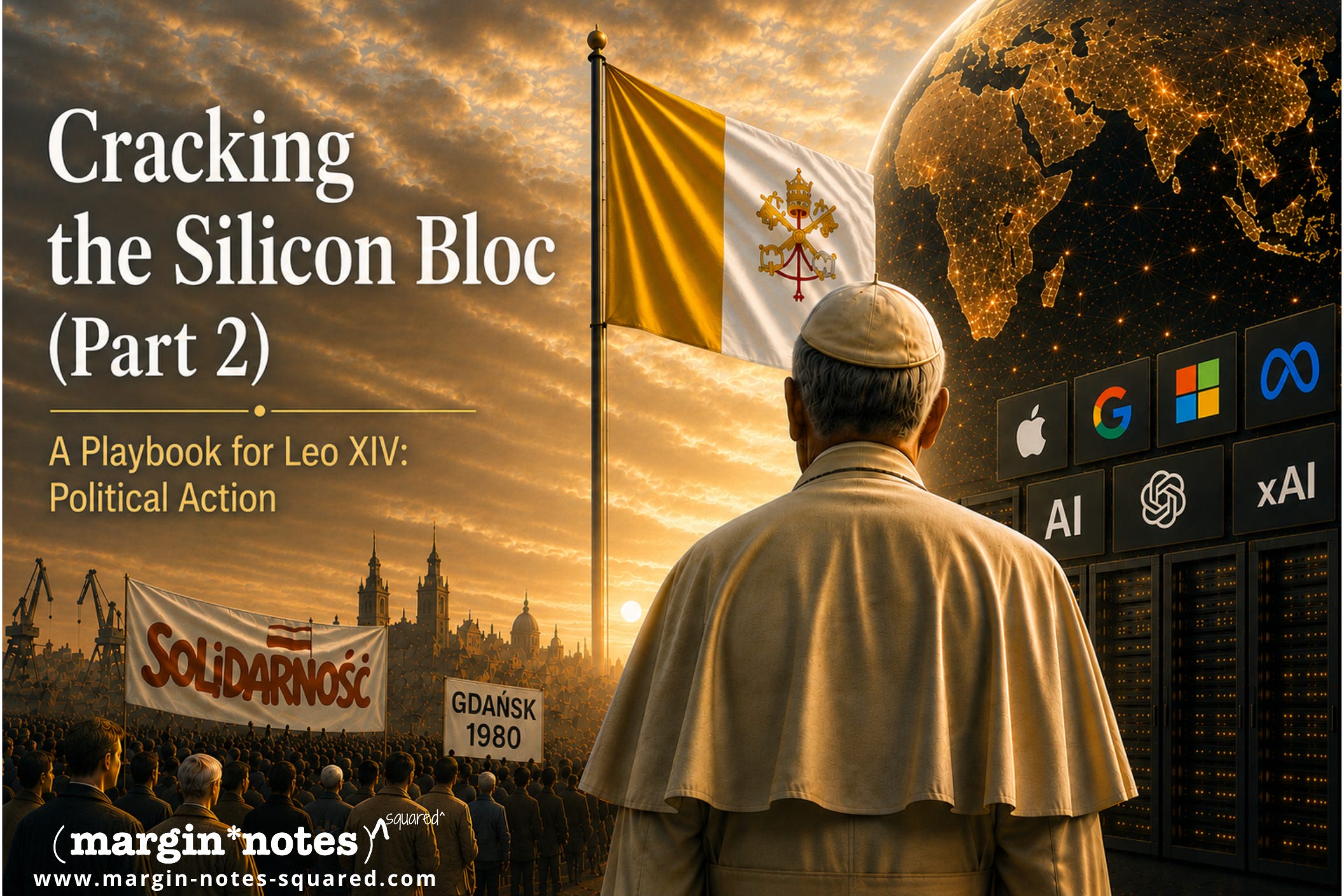
Last week, in Part 1 of this series, I attempted to reconstruct not the sainted version of John Paul II but the political-tactical one:
how he built a moral vocabulary the authoritarian Polish state could not suppress without suppressing Catholicism itself;
how the Church served as critical infrastructure when the Solidarność trade union and the pro-democracy movement it spawned;
how he helped make a Polish labour dispute into a global moral cause; and how “Don’t be afraid” was not a spiritual reassurance but a political diagnosis — the regime runs on your fear, stop supplying it.
Underneath all of it was the Holy Alliance: the CIA, the fax machines, the mismarked shipping containers through Gdańsk, and Reagan’s America absorbing the geopolitical risk that the Vatican could not.
The argument I ended on was quite simple: moral authority alone does not move geopolitical mountains. It moves them when it is organised, resourced and connected to actors willing to absorb risk on behalf of a shared interest.
In other words it requires moral authority, organisational infrastructure and coalition partners.
JPII aligned and strengthened all three.
Leo XIV has the first. Will he leverage the second and is it possible for him to build the third?
How to Run a JPII Playbook for the AI Age
This week I am exploring what it would actually look like to run the JPII playbook in a world where a dominant power to be cracked is not Soviet, but Silicon, where Washington is closer to the problem than to the solution and where the coalition has to be assembled laterally, across the global majority, the middle powers, and the communities that platform capitalism has been treating as extraction zones rather than citizen-stakeholders.
But first, the question of how to run a JPII playbook for the AI Age itself needs sharpening. When I asked last week “who Leo’s Reagan might be”, I am really asking something more complex: where can the equivalent of all three elements be found today — the moral vocabulary, the legal and institutional legitimacy, and the geopolitical coalition — when the usual democratic superpower is part of the problem rather than part of the solution?
The answer, I want to argue, is that while the Pope has great leverage over the first two elements, no single actor can drive the third. The coalition has to be assembled from different sources, laterally, across actors who may have rarely acted in concert previously.
This is, in a historical sense, a Bandung moment for AI governance: a coalition of the non-aligned, asserting that the terms of a new technological order should not be set unilaterally by those who stand to profit most and generate power from them.
The central question this raises is how Leo’s moral authority, absent a super empowered ally, can be converted into the kind of durable institutional and societal pressure that influences the policies on how AI is governed.
That is where the moral and political overlap. Where we go next.
Moral Foundation of Political Action
JPII’s rhetorical genius at the UN was to ground human rights in human dignity rather than purely Catholic catechism and theology — making his argument universally claimable and simultaneously undercutting any state’s pretension to grant or revoke rights by political decree. Leo XIV is attempting something structurally similar with AI, but the terrain is more challenging.
In last month’s Magnifica Humanitas, Leo XIV argues that “[i]n the abstract, technology in and of itself is not a solution to humanity’s problems, just as it is not inherently evil. In practice, however, technology is never neutral, because it takes on the characteristics of those who devise, finance, regulate and use it” (n. 9).
This is not a technophobic position, as he says that AI is not “a force antagonistic to humanity” nor “inherently evil.” The target is more exact: a “technocratic paradigm” that makes efficiency and profit the only measures of value, and in doing so reduces the human person to a resource. One of Leo’s central demands — that AI be “disarmed” — means freeing it from the logic of military competition, monopolistic control and cognitive arms races. “To disarm,” Leo writes, “means discrediting the assumption that technical power automatically confers the right to govern.”
What makes this vocabulary powerful beyond Catholic audiences is the same universalist move JPII made: a claim grounded in the shared moral inheritance of humanity rather than any single tradition. It is not a sectarian question to ask how AI concentrates power or distributes it, whether it serves the many or extracts from them. It is in fact the central political question of our time, and Leo XIV has stated it with clarity.
His further insistence that “a more moral AI is not enough if that morality is determined by a few“ is a direct challenge to the governance claims of Silicon Valley — that the industry can self-regulate. Leo XIV’s answer is that legitimate moral authority requires democratic accountability, broad participation, a preferential option for the most vulnerable; not corporate fiat.
Strategic Layer
The JPII precedent is instructive precisely because it was not purely aspirational: it strategically bolstered a specific social base, provided infrastructure and drew together a coalition that could absorb geopolitical risk. In other words, the moral vocabulary was the public face of a strategic machine that was the product of great effort by diverse collaborators to build.
To make real his guidance in the Encyclical, Leo must move beyond just the role of providing moral leadership to also mobilising the Church’s vast human, physical and financial resources and capacities to support a broad coalition as it translates the encyclical’s guidance into political and social action.
It’s now worth noting briefly one crucial difference between JPII’s moment and Leo XIV’s that cuts in his favour. The global civil society infrastructure that existed in the 1970s and 1980s — Amnesty International, the Helsinki monitoring networks, the international labour movement — was sophisticated for its time but operating with limited reach, slow communications and fragile funding. What exists today is orders of magnitude larger, faster and more connected. The organisations working on algorithmic accountability, data sovereignty, digital rights, AI governance and technocolonialism number in the thousands. The researchers, advocates, lawyers and community organisers who have spent years building the intellectual and institutional infrastructure for a just digital future are not waiting to be invented — they are already there, already making versions of Leo XIV’s argument in secular, technical and post-colonial vocabularies, already embedded in the communities most exposed to AI’s extractive logic. It is like having many, many Solidarność to lean on.
Unlike Solidarność JPII’s time, these are dispersed. They share the diagnosis but not always the strategy. They speak different languages — legal, technical, theological, political — and operate in different rooms. What the JPII moment had, and what Leo XIV’s moment currently lacks, is connective tissue: an institution capable of convening across those divides, lending moral authority to arguments that already have analytical rigour and holding the coalition together when the pressure to fragment is greatest.
That is precisely what the Church — at its best — is positioned to provide. Not as the leader of the coalition, but as its convener. Not as the source of the argument, but as an institution that makes the argument harder to ignore.
What follows attempts to sketch what that translation layer might actually look like. Because a coalition of the global majority and middle powers only becomes meaningful when it is made with levels of specificity.
An Emerging Playbook for Leo XIV
The comparison with John Paul II and Solidarność only holds if it is made honestly: JPII didn’t win through eloquence alone. He won because eloquence was backed by organisation, and organisation was backed by resources, and resources were backed by a powerful coalition that shared his strategic interest in the outcome.
What follows is an attempt to sketch what might make up Leo’s organisational layer — the specific, concrete actions and investments that would help make the moral vocabulary stick. All of them require the Church to spend political and financial capital – and to be visible.
Fund Local Knowledge Ecosystems.
The governance principles in Magnifica Humanitas will remain aspirational unless they are grounded in locally produced evidence about what AI actually does to people in the places it is deployed – how else to have preferential options for the most vulnerable if the knowledge comes from the North’s most privileged?
The research infrastructure that currently shapes AI governance — the think tanks, labs, and policy centres whose outputs become the reference points for regulation, standards, and international frameworks — is overwhelmingly concentrated in Northern institutions. This is a structural distortion that systematically excludes the lived realities, political economies, social values and governance contexts of the societies most exposed to AI’s extractive mechanisms. Local wisdom, practitioner knowledge and community experience are not supplements to the governing frameworks — they are the epistemic raw material without which those frameworks will continue to be built on false premises.
The Vatican has the institutional relationships, the convening authority and the moral credibility to make the resourcing of Southern knowledge production a governance priority — funding research centres and fellowships for non-sectarian, locally grounded research and insisting that the expert rooms where AI governance is designed include architects, not only observers, from the regions that bear the costs. This connects directly to emerging regional efforts — in Asia, Africa, and Latin America — to build homegrown intellectual ecosystems capable of producing decision-ready, context-specific AI governance knowledge at the pace and scale that the policy moment demands.
Leo XIV’s encyclical already names the problem and resourcing the knowledge infrastructure to solve it is the institutional follow-through.
“Visit the DRC.”
John Paul II’s 1979 Poland visit was not a diplomatic event — it was a pastoral one, and the distinction mattered enormously. He did not go to meet the government. He went to be with the people, in their parishes and town squares; the regime had no script for what happened next. Leo XIV has an equivalent moment available to him: a visit to the Democratic Republic of Congo — to the mining communities of the Kivus, where coltan and cobalt are extracted under conditions that make AI infrastructure possible and human dignity theoretical.
Sister Professor Léocadie Lushombo, who spoke at the Magnifica Humanitas launch, reflected on workers who say “we work in our graves.” A papal visit shaped around that reality, drawing the direct line between the device in your pocket and the body in the mine, would be an act of moral witness with global reach. It would also be politically unignorable in a way that encyclicals alone are not.
But this is also urgent: “Visit the DRC” is just shorthand for a geography of harm that runs much wider. Some ideas where Pope Leo XIV could visit:
Indigenous farming communities of Chile, Bolivia and Argentina’s lithium triangle, where aquifers that have sustained life for generations are being drawn down to supply the batteries that power AI hardware.
Content moderators in Nairobi or Manila — the ghost workers who spend their days labelling data and reviewing violent content under non-disclosure agreements and with minimal labour protections, so that AI systems function smoothly for users who will never know their names.
Farmers whose access to credit, insurance and market prices is now mediated by algorithmic systems they cannot see, contest or appeal.
Communities in the American Southwest or the Netherlands where municipal water supplies are under measurable pressure from the cooling demands of hyperscale data centres — a reminder that this is not a developing-world problem neatly contained elsewhere, but a systematic one that lands on someone, somewhere, every time a model runs.
The pastoral visit is not a communications strategy. It is the oldest tool in the Church’s repertoire for making an abstraction — suffering, human dignity, justice — impossible to ignore.
Weaponise the vocabulary.
John Paul II gave Solidarność more than solidarity — he gave them a moral language that was simultaneously Christian and universally legible, one that could be spoken at the UN as readily as in a Polish church. Leo XIV has already done the equivalent linguistic work as we’ve covered. But vocabulary only becomes power when it is carried by advocates into the rooms where decisions are made.
The Vatican should embrace a deliberate strategy for seeding this language — through Vatican delegations at ITU and UNESCO meetings, through briefings to receptive parliamentarians around the world and through formal partnerships with civil society organisations that can translate Leo’s concepts into legislative and regulatory text.
JPII’s language didn’t spread by itself. It spread because Solidarność printed it, taught it and refused to let the regime replace it with its own.
Leverage the infrastructure.
The Church’s material footprint could be one of the most under-appreciated geopolitical assets in the world: people, schools, hospitals, parishes and social action in virtually every country where tech companies are currently extracting data, expanding platform reach or deploying AI systems with minimal local accountability. In Poland, this infrastructure — the parish networks, the Catholic publishing houses, the underground circulation of samizdat — was what made John Paul’s moral vocabulary organisationally real and vibrant.
The 21st century equivalent is not underground printing; it is digital literacy, data rights advocacy and community organising against the technocolonial — at every level from the parish to the parliament. A Catholic school in Jakarta teaching students about data rights feeds into a national civil society coalition pressing for a citizen-centred AI regulation. A diocesan network in Brazil aggregating local experiences connects to regional bodies bringing evidence to ASEAN or African Union AI governance processes. A Vatican delegation tables those positions at the ITU or UNGA alongside middle power governments and secular advocacy organisations that share the diagnosis but lack the institutional reach. No single actor can do all of this. The Church can become a connective tissue to link them.
This infrastructure exists. Encouraging, supporting and even financing it to materially influence AI governance would be the most concrete thing Leo XIV could do to turn the encyclical into ground-level reality.
Use the Holy See’s UN standing.
The Vatican’s permanent observer status at the United Nations is structurally unique: it confers the ability to speak, convene and engage in diplomatic negotiations in ways that no NGO, think tank or civil society coalition can replicate. The Holy See currently has diplomatic relations with over 180 states — more than most countries — and a track record of effective multilateral engagement on issues from landmines to climate.
This standing is chronically underused on frontier technology governance.
Leo XIV could deploy it with genuine strategic intent. Some of the most consequential conversations in AI governance right now are not yet about treaties — they are about the standards, risk taxonomies, audit frameworks and technical benchmarks being developed in multilateral bodies like ITU and ISO (and within national bodies of the United States, such as NIST) that will eventually harden into de facto global rules.
Whoever shapes those technical foundations shapes everything that follows. The Holy See could use its convening authority and diplomatic relationships to ensure that middle voices and expertise from middle powers (especially among the global majority) are at those tables as architects rather than recipients. This can help ensure that the values embedded in Magnifica Humanitas are present in the rooms where the technical language is being written, before that language becomes binding on everyone. This is nearly an insurmountable challenge for an NGO. The Holy See can do this.
It must spend the political capital.
Centre the Global South as protagonists.
The risk in every well-intentioned Northern institution’s engagement with the Global South is the same: advocacy on behalf of, rather than power shared with.
Leo XIV’s decision to have Léocadie Lushombo speak at the Magnifica Humanitas launch as a peer intellectual contributor alongside cardinals and AI researchers was a signal. Signals need institutional follow-through.
The Vatican is already convening on AI governance and drawing stakeholders from around the global majority (for example, in my region, last year the Office of Social Communications of the Federation of Asian Bishops’ Conferences convened in Hong Kong to address the pastoral impact of AI).
These moments seem to largely escape mainstream attention. That is the problem. Convenings that are reported only in specialist Catholic publications and niche technology policy journals are not doing the political work that Leo XIV’s encyclical demands.
But more importantly, the signal sent by having Léocadie Lushombo on the stage at the Magnifica Humanitas launch needs to become the operating principle rather than the exception: Global South advocates, researchers and policymakers designed into the process from the outset as architects — setting the agenda, framing the questions and owning the outputs. And the outputs of those convenings must be visible, cited and consequential in the rooms where AI governance is being decided.
This is the difference between consultation and co-production. It is also the difference between a Church that comments on history and one that participates in it. The most credible challenge to Silicon Valley’s governance claims is not a European regulatory framework or a papal encyclical read in Rome. It is a Global South majority asserting, alongside one of the most universally recognised moral institutions in the world, that the terms of AI governance must be set by those who bear its costs — and being seen to do so.
Strengthen the interfaith flank.
John Paul II operated in a predominantly Catholic country against a communist state. Leo XIV is operating in a global arena where the Church’s credibility is amplified, not diminished, by coalition. Major faith communities all have substantial theological resources for critiquing the reduction of persons to data — and together they represent the majority of the Global South’s population.
The groundwork already exists. In July 2024, representatives of world religions expanded the Rome Call for AI Ethics (originally launched in 2020) in Hiroshima — a remarkable interfaith convergence (drawing from Christianity, Buddhism, Hinduism, Islam, Judaism, Zoroastrianism and Bahá’í, among others) that received less broad-based attention than it deserved.
Leo XIV’s task is not to necessarily convene something new from scratch but to elevate what already exists: making the Rome Call a moral reference point for international AI governance discussions, giving it the institutional weight of the full Vatican diplomatic apparatus and ensuring it is present in the technical standard-setting bodies where the real rules are being written.
The Holy See has the convening power. These are the moments to use it without hesitation.
Engage the tech companies — conditionally.
Chris Olah’s presence at the Magnifica Humanitas launch was not accidental. There is a faction within the AI safety and AI ethics community that genuinely wants external moral accountability and recognises the Church could provide it. Leo should pursue that track selectively and publicly — not as validation of the industry’s self-governance claims, but as conditional engagement with specific, auditable asks.
JPII never refused to talk to communist officials; he just made clear what he was asking for and held the line. The equivalent here is engagement with clear designs on ensuring technology serves citizens first and foremost – which includes transparency requirements, labor protections, data sovereignty commitments and much else as preconditions rather than aspirations.
The Coalition Question
Who plays the role of the Polish Pope’s coalition partner in this AI story? The honest answer is: no single person or state. The JPII model depended on a super empowered democracy willing to absorb geopolitical risk on behalf of a shared strategic interest. That singly powerful coalition partner does not exist for Leo XIV, and waiting for one would be a category error — the Silicon bloc has no Cold War adversary whose defeat requires a pope.
The coalition Leo needs is structurally different: not a superpower patron but a network.
The Vatican may be one of the very few institutions that cuts across all of them — present in every jurisdiction, trusted across ideological lines and holding a moral vocabulary that none of them can generate independently. The coalition Leo needs isn’t a super empowered democratic state — it’s a super empowered distributed network of policymakers, civil society organisations, academics and advocates who are already making versions of this argument in different vocabularies, waiting for connective tissue.
So what does the operational layer of this coalition actually look like?
In the 1980s, the U.S. provided Solidarność with the material infrastructure of resistance: fax machines, printing equipment, communications technology and the funding to keep an underground information network alive against a state that controlled every official channel. The U.S. government funded fax machines because the terrain of contest was access to information — the regime controlled every official channel, and simply getting uncensored truth to people was an act of resistance. That battle has largely been won.
The terrain of contest now is epistemic authority: whose knowledge counts as credible evidence in the rooms where AI governance is decided, whose risk frameworks become the baseline and whose experts shape the standards before they harden into frameworks that exclude everyone else.
The equivalent of the fax machines today looks like:
Funded research and investments in knowledge infrastructure across the global majority that feeds directly into regional regulatory processes — producing locally grounded evidence at the pace and scale the policy moment demands
A shared legal monitoring network that tracks how AI systems deployed in Global South markets actually behave — the algorithmic credit denials, the biometric surveillance contracts, the data extraction terms buried in platform agreements — and surfaces that evidence in forms that legislators and UN agencies can use
Translation capacity: people who can take the vocabulary of Magnifica Humanitas and render it into the specific legal and political languages of the ITU, the WTO, the African Union’s data governance frameworks and ASEAN’s digital economy agreements
Convening infrastructure — the ability to get the right people in the same room, repeatedly, outside the conference circuit that Northern institutions already dominate
None of this is glamorous, but all of it is necessary. And the Church has the institutional relationships, the geographic reach and the moral credibility to help resource and convene it.
Coda
Return to the question. John Paul II did not crack the Soviet bloc because the Church was powerful. By the metrics of hard power — armies, budgets, nuclear arsenals — the Church had none of what mattered. He cracked it because he was right at the right moment, and because he gave people the tools to act on what they already knew but had been told to doubt.
The moral argument didn’t create the resistance. It unlocked it.
That distinction matters enormously for how we assess Leo XIV’s prospects, because the same conditions are present. The people living under the extractive logic of platform capitalism — in the mines, the content moderation farms, the communities losing their water to data centres, the lives of people experiencing AI-enabled discrimination — do not need to be told that something is wrong. They already know. Now is the time for the Church to proactively share the vocabulary, the organisation and the institutional backing to act on it.
What makes this moment genuinely different from JPII’s intervention in geopolitics is that the network already exists, distributed around the world. While John Paul II had to bolster Solidarność from within a surveillance state, against active suppression, over years of patient organisational work, Leo XIV does not face that problem. The researchers building homegrown AI governance knowledge ecosystems in Asia and Africa, the advocates carrying the language of digital sovereignty into UN meetings, the scholars working on what legitimate global governance actually requires — these are not waiting to be recruited. They are already there, already making versions of this argument, with growing sophistication and urgency. What they lack is not conviction. It is connective tissue.
That is the specific gap the Church is positioned to fill and that, today, perhaps no other institution can fill in quite the same way. Not the EU, whose regulatory authority stops at its borders. Not the UN, whose processes move at glacial pace. Not the civil society coalitions, whose legitimacy is real but whose reach is bounded. The Church is present everywhere the harm is occurring, trusted by populations that neither Brussels nor Washington can easily reach, and holding a moral vocabulary that has — once before in living memory — proven capable of changing the terms of a geopolitical contest that appeared settled.
The JPII story is not a template. The Cold War is over, the adversary is different and the terrain of contest has shifted from the shipyards of Gdańsk to the data centres, mine shafts, content moderation farms and legislative chambers where the rules of AI are being written right now, without most of the world in the room.
But the underlying logic holds: moral authority, organisational infrastructure and a coalition willing to act in concert can move things that pure power cannot.
The question for Leo XIV — the genuinely hard one — is whether the Church will follow through with the concrete, possibly uncomfortable, geopolitically risky work that the argument demands. Whether it will spend the political capital, visit the difficult places, fund the knowledge infrastructure, weaponise the vocabulary and show up not as a moral commentator on history but as a participant in it.
That coalition does not yet have a name. It is being assembled, piece by piece, in exactly the places this article has tried to describe — in the Kivus and the lithium triangle, in the fellowship programmes and policy institutes of the Global South, in the UN corridors where middle powers are looking for a common language, and in the Vatican itself, where an American pope who grew up in Chicago is asking what the Church owes the world it claims to serve.
In this way, Pope Leo XIV might yet do to the Silicon bloc what John Paul II did to the Soviet one.