

Digital Landlords
America’s Failed Capitalism – and lessons from a hardware store

SERIES NOTE — This is the third in what has organically emerged as a series on perspectives of the political economy of AI from the margins. Part 1: Food Deserts. Or Just Deserts? — on who can afford the tools, Part 2: Empathy Is No Algorithm — on who’s building them, Part 3: This piece — on the economic and corporate leadership model driving it all.
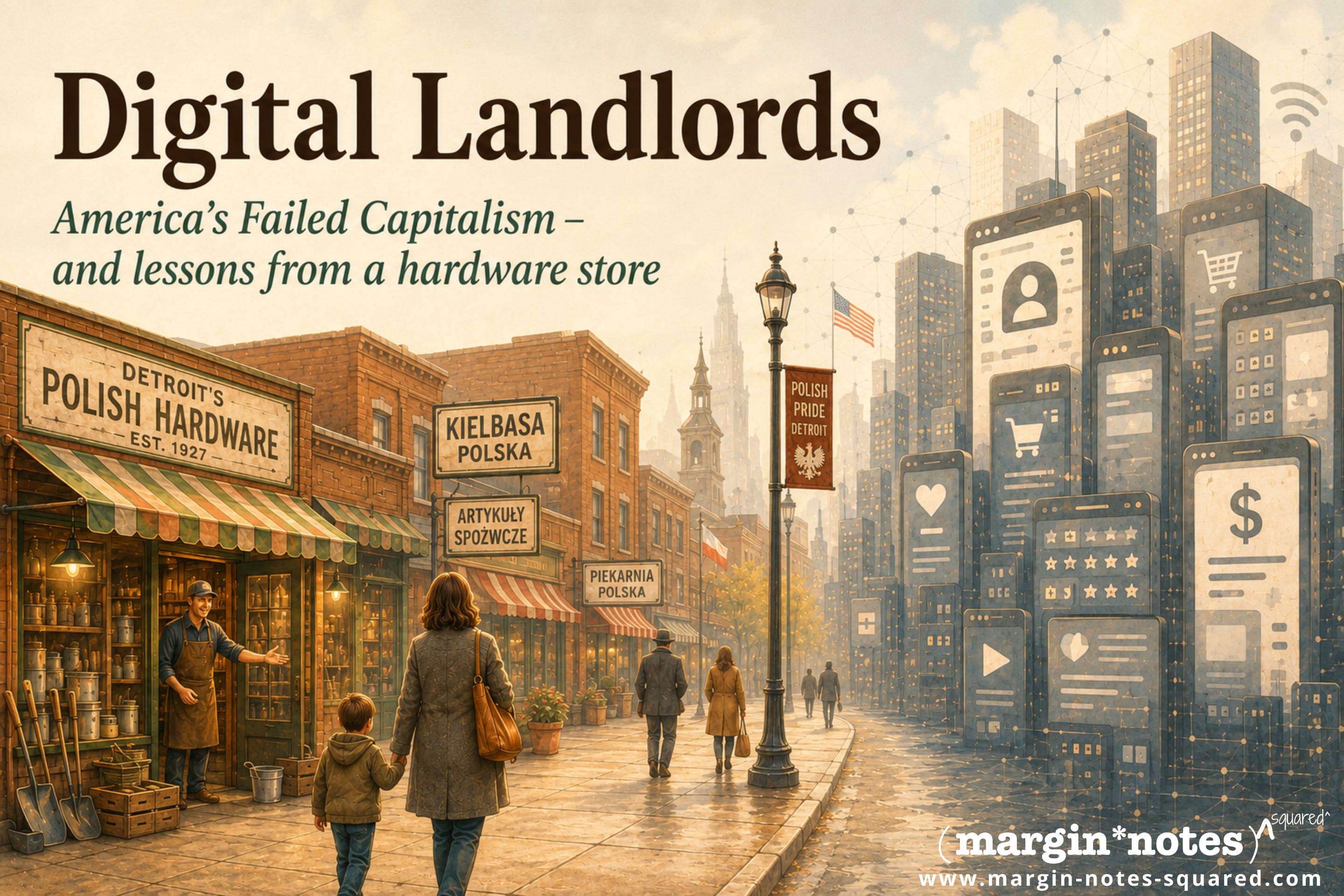
Back when Detroit was still very much one of America’s largest and most vibrant centres of Polish-American life, my grandfather owned and ran a hardware store. He served the Polish community — neighbours, really — as well as anyone who walked in needing help to fix something, improve their home, or find the right tool for a project they’d been putting off. He knew his customers and they knew him. My grandfather knew who tinkered and who seriously built stuff. His people weren’t abstract entities who periodically exchanged money for goods; they were relationships, real flesh and blood relationships — ones that created value for everyone involved and wove a kind of mutual support that made the neighbourhood stronger.
My grandfather always admonished me to be honest, respect others and always deliver the best you can. As a child I knew what it meant, but as I’ve grown older I increasingly know why.
Leadership
Not long ago — within living memory, really — businesses existed to serve their customers. This was not naïve idealism; it was practical logic. The customer was the lifeblood of the enterprise. Centering them — ensuring they got genuine value for money, that their time and resources were respected — was simply how you stayed in business. The relationship was symbiotic: businesses needed customers to survive; customers needed businesses to function. What emerged was something like an ecosystem of mutual benefit, with serendipity, loyalty, and genuine human connection as its natural by-products. All of which folded into and strengthened bonds of trust, the essential currency of society.
My sister has a phrase for the stewardship model that flows from this: servant leadership. The idea, which we discussed when I was preparing for a job interview a couple years back to lead an international NGO, is that the leader’s primary role in any organisation is to serve: to help employees grow, evolve, prosper and flourish. The servant leader centres other people’s humanity rather than subordinating it to institutional ends or as instruments to their own advancement. We agreed that servant leadership is the optimal way to genuinely build impactful teams that create value for society. After all, you cannot nurture people or create societal trust while treating them as mere instruments.
The same logic applies to businesses and their customers. You cannot build a genuinely sustainable enterprise while treating the people you serve as extraction targets.
And yet, here we are.
Friedman Doctrine
In 1970, the American economist Milton Friedman published an essay in the New York Times Magazine that would reshape the ethics of American business for decades – and also shape how America heavy handedly exported its system to the world. His central claim was blunt: “there is one and only one social responsibility of business—to use its resources and engage in activities designed to increase its profits so long as it stays within the rules of the game.“ Not to serve customers. Not to sustain communities. Not to treat employees as human beings with interests worth respecting. To increase profits. Full stop.
Indeed, Friedman pulled no punches when he opened his 1970 essay with these chilling lines:
“The businessmen believe that they are defending free enterprise when they declaim that business is not concerned “merely” with profit but also with promoting desirable “social” ends; that business has a “social conscience” and takes seriously its responsibilities for providing employment, eliminating discrimination, avoiding pollution and whatever else may be the catchwords of the contemporary crop of reformers. In fact they are—or would be if they or any one else took them seriously— preaching pure and unadulterated socialism. Businessmen who talk this way are unwitting puppets of the intellectual forces that have been undermining the basis of a free society these past decades.”
Here it is important to note that generations of Americans have been convinced of this notion that socialism is a euphemism for evil communism – the big, bad bogeyman lurking under and around any reform effort to fix America’s broken system. So Friedman’s opening amounts to a massive, massive shot across the bow.
This was the Chicago School of economics distilled into easily understood permission that was eaten up by the wealthy classes, while the logic seeped downward through schools, media and political culture to shape how ordinary citizens understood the purpose of business in America’s “free market”. (Reagan called it “trickle down economics” — really just bunk from the start.) And it worked — not because it was true, but because it was enormously convenient for the people with the power to implement it. Shareholder primacy became the operating system of American capitalism. Customers became consumers. Employees became human resources. Communities became externalities.
My grandfather ran his hardware store on a completely different set of assumptions and values. He would have found Friedman’s doctrine not just wrong but incomprehensible — the idea that a business owed nothing to the neighbourhood it inhabited, nothing to the people who kept it alive, nothing beyond the numbers at the bottom of a balance sheet.
Enshittification
Cory Doctorow, in his essential book Enshittification: Why everything suddenly got worse and what to do about it, has given us the perfect word for what the Friedman doctrine produces when applied at scale and over time. Enshittification describes the process by which platforms and products are progressively degraded — first to extract more value from users, then to extract more value for shareholders — until the thing you once relied on becomes a pale, hollowed-out shadow of what it was. I recommend the book without reservation

.The examples are everywhere once you pay attention and start looking. American air carriers used the cover of 9/11 to abandon in-flight meals, then spent the next two decades inventing new ways to charge passengers for things that were once simply included: checked bags, seat selection, boarding priority, even overhead bin access. What was once a service became a sequence of upsells. The passenger — no longer a traveller but a revenue opportunity — is now expected to be grateful for being allowed to sit in a seat they’ve already paid for.
Software is another casualty. I used to buy programmes — own them, install them, use them indefinitely. Now I rent them. Microsoft Office, once a product, is now a subscription. TurboTax, once a purchase, is now a recurring fee. The total cost over time is higher; the relationship of ownership has been replaced by a relationship of permanent dependency. And while I pay my monthly rental fee, my usage patterns, my data, my behaviour are being harvested and monetised by the landlord.
Digital landlords. That is what they are. You pay rent, and they still go through your drawers.
This logic has not remained solely within the tech sector. My sister and I were chatting a few weeks back and landed on something interesting: the enshittification of products reflects a deeper enshittification of corporate leadership itself — a generation of business elites who have so thoroughly internalised Friedman’s doctrine that they have lost the capacity to imagine a different relationship with the people they serve. This American capitalism, with a Friedmanian obsession with growth (profits for shareholders!), was carried into the world through the long arms of American government and non-governmental agencies as part of an operating logic of freedom and the free market. The Bretton Woods institutions were formed and shaped into America’s image and have done the same.
The export of the Friedman doctrine was not accidental. It was policy. Remember the Washington Consensus?
Enshittified indeed.
e/ensh
Into this landscape arrived the libertarian tech class — the venture capitalists, the founders, the platform builders who took the Friedman doctrine and turbocharged it with the rhetoric of disruption, the mathematics of exponential returns and quasi-religious faith in the inevitability of technology they call effective accelerationism, or e/acc.
Or, as the evidence increasingly suggests: effective enshittification. e/ensh, if you will.
Unless these models of business change (voluntarily or through regulatory coercion), the products they peddle exist on the enshittification spectrum from day one.
As Doctorow has show us, the mechanism works like this: a genuinely promising technology is identified. Venture capital floods in at valuations that require enormous eventual returns to justify the investment. The technology is scaled aggressively, often at a loss, to capture market share and build dependency. Once the dependency is established — once users, institutions, or governments have built their operations around the platform — the extraction begins. Prices rise. Features disappear behind paywalls. Terms of service shift. Enshittification accelerates.
This is not an accident or a failure of the model. It is the model.
What gets lost along the way is what the technology could have been, had it been built to serve people rather than to capture them. Genuinely transformative technologies — ones with the potential to improve lives across the full spectrum of human circumstance — get bent toward the needs of the investor rather than the needs of the citizen. The result is technology that is spectacular for those who can pay for the premium version, and enshittified for everyone else.
And all this is made possible by “leadership” that has generally succumbed to enshittification itself.
AI and the Global Majority
We are now at the beginning of what may be the most consequential technological transition of our time. An essential question, and perhaps an uncomfortable one, is whether we in the Rest of World can afford to let this American e/ensh model define how artificial intelligence is built, deployed and distributed (and governed!) in our communities, societies and within our institutions.
For the global majority, the answer is hard no.
I see the consequences playing out on two tracks.
The first I’ve written about before. If you’ve read my piece on the AI access divide, you’ll know Siti — the young woman with a cheap smartphone and a fellowship deadline, competing against someone with a laptop, a premium subscription and a second monitor. The gap between the AI-augmented and the non-augmented is already a gap in competitive capacity. As AI tools become more central to professional life, education and civic participation, that gap will widen into something more fundamental: a divide in who can participate meaningfully in the societies these technologies are reshaping. Absent restraining and countervailing forces and rules, venture capital and the private interests they fund have little incentive to close this gap. The global majority is not the market they are building for – it’s the market they’re extracting from. The pursuit of endless growth to feed the beast requires enshittifying what would otherwise be possibly great things.
The second track is discrete but perhaps more corrosive. Across the world, private enterprises are taking over the delivery of services that were once public goods — healthcare administration, education platforms, welfare systems, public transportation, urban infrastructure. When those enterprises are driven by the Friedman doctrine, the profit motive is structurally at odds with the public purpose the service is supposed to serve. Citizens become users. Users become revenue streams. And the enshittification of public life accelerates.
Applied to AI, this means that the systems increasingly mediating our access to healthcare information, educational resources, financial services, information and civic processes will be optimised for shareholder return — not for human flourishing. The negative externalities, as always, will be distributed to those least able to push back, while profits are internalised for shareholders. The global majority will absorb the costs while the returns flow to the shareholders of a small number of American corporations.
This is not a prediction. It is already happening.
My Grandfather’s World
My grandfather would not have recognised or uttered the word enshittification – he never used a cuss word, at least not in English. But he understood its opposite — intuitively, practically, in the daily life of his hardware store in a Polish neighbourhood in Detroit.
He understood that a business exists within a community, not above it. That the customer across the counter is a neighbour, not a target. That trust, once extracted from, is gone. That leadership and stewardship matter. That the ecosystem of mutual benefit — where customers thrive because the business serves them well, and the business thrives because customers return — is not a quaint relic of a pre-capitalist past but a model of sustainable human organisation that Milton Friedman decided had to be abandoned – and easily brought along the business establishment to make that happen.
The good news, however, is that this was a choice.
Which means it can be unchosen.
Middle powers and nations across the global majority are not obliged to import the enshittified version of technology and tech leadership that American capital will otherwise deliver to them. They can regulate against the most extractive behaviours and business models of venture capital. They can require that AI systems deployed in their jurisdictions meet genuine standards of equity, transparency and public benefit. They can invest in local AI ecosystems — in knowledge generation, technical capacity and policy infrastructure — that allow them to shape these technologies rather than simply absorb them. The Sustainable Development Goals provide one existing framework for what human-centred technology deployment could look like: centering equity, sustainability and the wellbeing of the most vulnerable rather than the returns of the most powerful.
It will not be easy. The libertarian tech class has deep pockets and strong incentives to resist meaningful regulation. But the servant leadership model — the one my grandfather practiced in his hardware store, the one that centres human beings rather than shareholder returns, the one my sister taught me about through her own example — is not a fantasy. It is a choice that has been made before. And it is one the global majority has every reason to make again.
Enshittified indeed. But not irreversibly so.