

The Convergence
The Preferential Option for the Poor Has Demands on AI

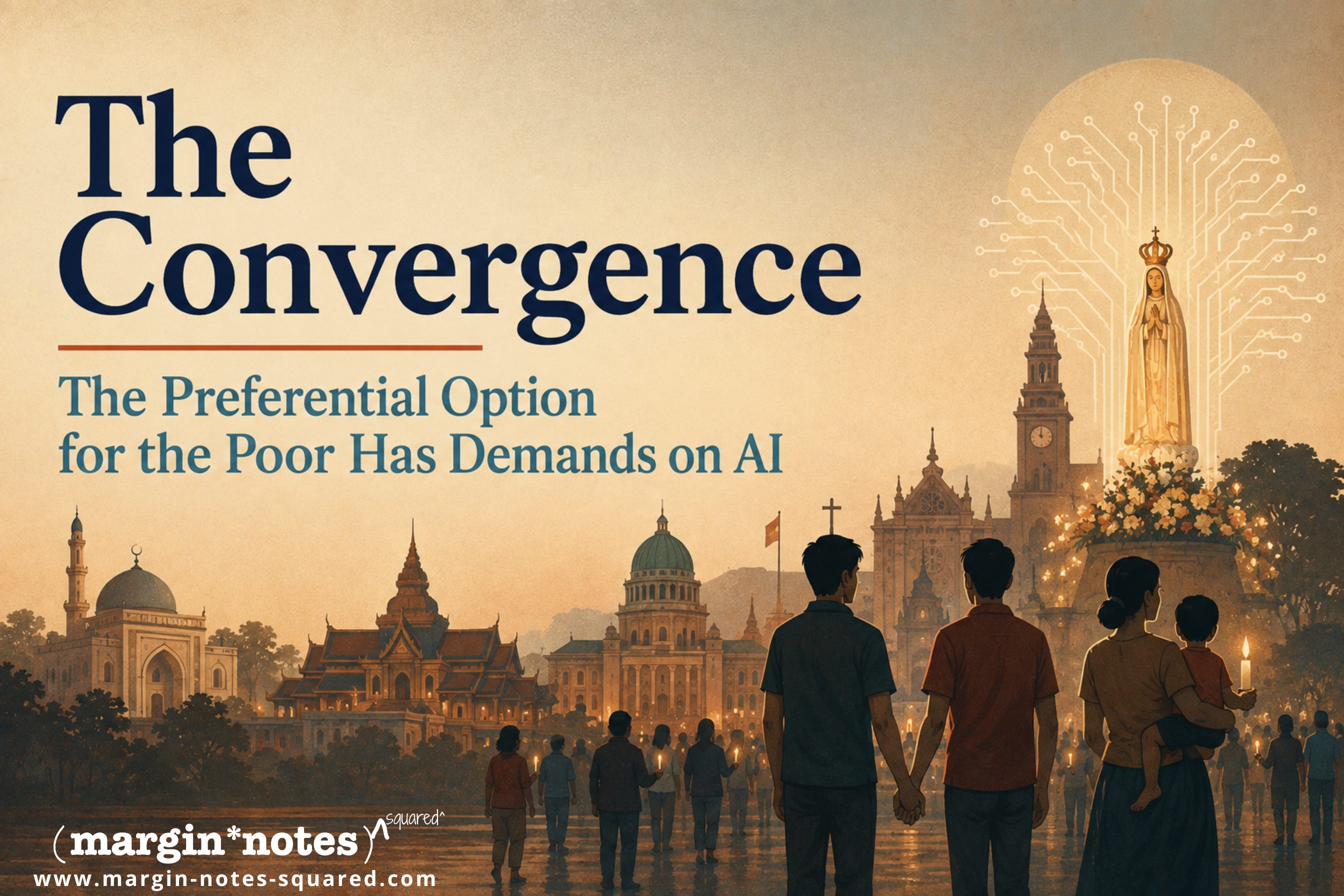
I’m writing this essay from Fátima, Portugal, where I’ve come on a pilgrimage on behalf of my best friend, to make merit for his parents who recently passed away tragically. I joined the vigil service, which includes a procession carrying an image of Our Lady of Fátima around the outdoor sanctuary — the size of a dozen football fields, I’d reckon. I lit my two candles, one for each of my friend’s parents, from the flame of a Filipino family standing in front of me. They had just been asked to be part of the small group of people who would carry the sacred image around the outdoor sanctuary. My friend’s parents were devout Filipino Catholics. What are the chances, eh?
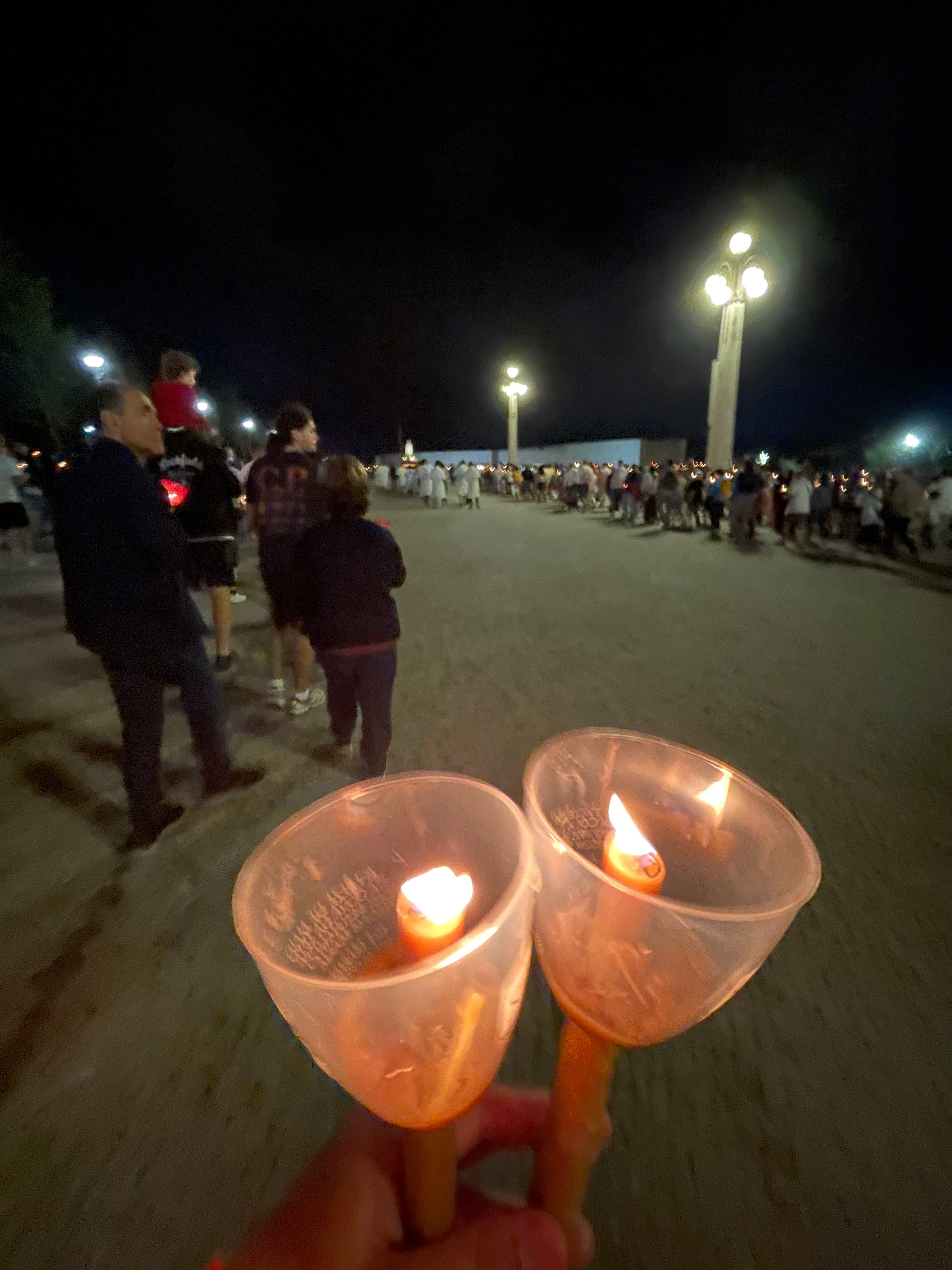
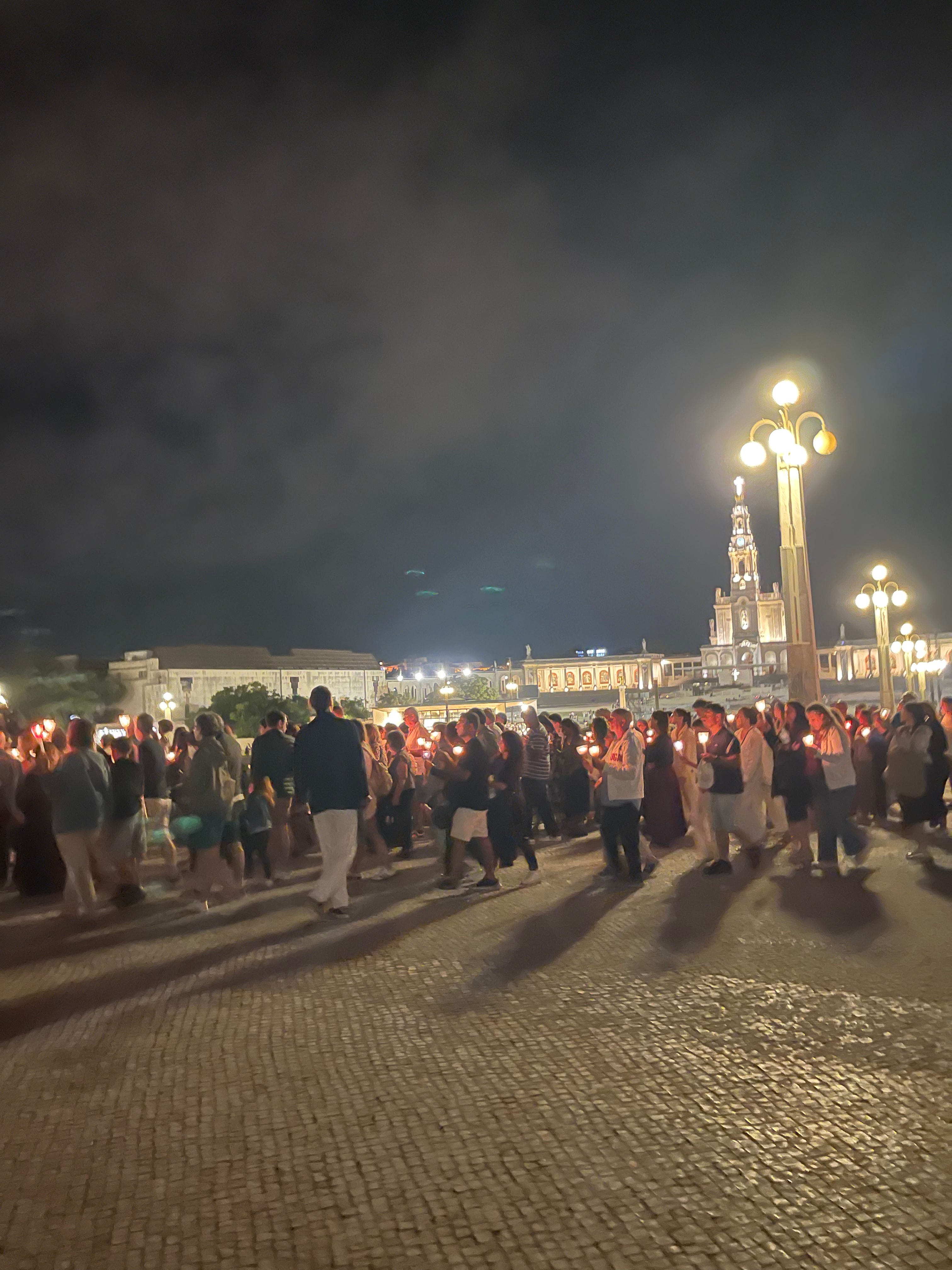
If you’ve ever joined a pilgrimage or really any large religious ceremony of any kind, they have a particular power to them. You feel yourself awash with equal parts joy and equal parts sadness — joy for the life you have, sadness for the recognition of how you’ve fallen short at times. You think about the living, the dead and what comes after this one wild and precious life (to quote Mary Oliver). You feel yourself part of a community, many of whom are, in fact, quite different from you. Prayers said aloud in a few languages you don’t fully understand, and responses made in even more languages, combine into a sensory experience that seems to send inspiration of all sorts up your spine.
This isn’t just about Fátima. I’ve had similar feelings visiting other holy sitesm ceremonies meant to draw people together — the Istiqlal Mosque in Jakarta and the Blue Mosque in Istanbul, Buddhist temples at the heart of Theravada practice in Yangon and Bangkok, the Wailing Wall, Shinto Shrines in Japan, the Church of the Holy Sepulchre in Jerusalem. I’m blessed with many such experiences: churches big and small, synagogues of all types, temples and shrines, mosques rebuilt in the ruins of a tsunami, and other sacred sites I still have much to learn about.
What’s in common across all these experiences is the personal reflections that takes place. You really can’t help it, regardless of your faith. But it’s all real. Everyone there experiences that same reality, at the same time. You feel it in your mind, in your heart and in your bones
You feel it.
As I walked around Fátima making merit for my friend, I saw so many different colours of people — thousands and thousands of them. Surely some had faith that was hanging by a thread, while others were more devout than I could ever imagine. I saw pilgrims crawling on their knees along the marble pathways, some holding their small children, others clearly in pain, others with tears running down their cheeks. I saw people manifestly Muslim, manifestly Buddhist. All exploring. Watching. Taking part in something so human, so manifestly part of humankind, that it cannot be ignored.
On Technology
This is our world. This is our life. Encounters with religion, faith — any sort of the divine — is part and parcel of our existence as human beings.
Yet when it comes to the usually antiseptic work of policy, or diplomacy, or any manner of technology, we tend to treat all of this as irrelevant — particularly in much of the global north.
I’ve written before about how we all deserve the butterflies — I even talked about it on the podcast “Between Us and the Machine”! Walking with the crowd holding candles in Fátima in the chilly summer evening, it dawned on me: we also all deserve the goose bumps, the tears that well up as you feel some strange elation or sadness or inspiration or or or, and these moments of reflection — a deep connection with whatever is divinity for us.
At this point you should rightly be asking yourself what all this has to do with decolonising policy or governing AI or shaping the evolution of frontier technology. Isn’t that all its own separate category?
No. It is not.
Faith traditions give us moral frameworks through which we engage the world and people around us — how we should treat others, and how we’d like others to treat us. They also don’t typically just impress these moral frameworks on us; they also share tools for building meaningful lives and thriving communities. (I’ll set aside, for now, the very real ways religion has been hijacked for political ends, often disastrously.)
Faith matters in our world. As humans, faith serves important roles in shaping our behaviours, interactions and communities. And just as language, culture, and capability all matter greatly for how societies function, faith matters just as much for our technological future. Currently, that future is one that an elite few are building while the Rest of Us have little voice in shaping how powerful technologies should serve us, not the other way around.
Left guided solely, or even largely, by silicon values, AI has the tendency and the power to crowd out part of our shared humanity stewarded by faith. This crowding out occurs twice over: marginalisation (and at worst, displacement) of the moral leadership roles of faith leaders, and also weakening of the moral and ethical guardrails faith traditions have provided us which help us to grow, thrive and hold shared experiences and perspectives with one another.
I think faith leaders and faith institutions — of every tradition — have a critical role to play as a countervailing force against those whose blind faith in technology, for technology’s sake, is reshaping how we interact with each other, our lives and our world. (Yes, there’s a word for that quasi-religious faith in inevitable technological acceleration: e/acc.) Also, I mustn’t forget, alongside faith leaders are the philosophers among us. What both groups share is the capacity to create, explain, and strengthen moral frameworks — the moral lighthouses we need in our lives.
So, what?
Here’s the specific thing faith leaders and traditions can bring to this conversation, and it’s not a vague appeal to “values.” It’s a knowledge claim, about how you come to know the truth about something (a philosopher would call this an epistemic claim);
You learn what’s actually true about a system — a society, an economy, a technology — by attending to how it treats those with the least power within it, not those with the most.
For example, Roman Catholic social doctrine, and liberation theology in particular, calls this the preferential option for the poor. It’s not a phrase about charity; but a call to action. And it turns out this is not a uniquely Catholic idea that just so happens to be shared by a few others — it’s a structural convergence, arrived at independently, by traditions that may seem super far apart otherwise.
Apart from Roman Catholicism, consider:
Islam has zakat — obligatory redistribution, not optional charity — and a broader ethic that judges a society’s justice by its treatment of those on the margins.
Judaism has tzedakah, meaning righteousness or justice, which is a basic moral obligation to do what’s fair and right, and that humans act as stewards of God’s resources, entrusted to share them with those in need.
Buddhism starts with suffering, dukkha, to understand the nature of a system by locating where it produces suffering rather than comfort.
Māori tradition centres manaakitanga — the obligation to actively uplift the dignity and wellbeing of others — alongside kaitiakitanga, the responsibility to act as steward rather than owner. We do not own what we build; we hold it in trust for those who come after us, and we will be judged by what it does to them.
Sikhism builds this into its daily practice through vand chakna — sharing what you have — and seva, selfless service, most visibly in the communal kitchen that feeds anyone who walks through a gurdwara’s doors, no questions asked.
Aboriginal and Torres Strait Islander traditions embed obligation to the vulnerable within kinship structures — care as relational duty. (And notably, First Nations communities across Australia and the Pacific have been building some of the most sophisticated data sovereignty frameworks around: the insistence that data about a people belongs to that people, not to whoever collected it.)
Hindu tradition holds vasudhaiva kutumbakam — the world is one family — alongside dāna, giving as sacred obligation. The Arthashastra and later traditions judge the legitimacy of governance by whether it produces flourishing for all, not accumulation for the few.
And Jainism teaches aparigraha — non-possession, the restraint of accumulation beyond genuine need — rooted in parasparopagraho jivanam: souls rendering service to one another.
These are not coincidences. They are convergences.
And they illustrate exactly the same claim I’ve made in an earlier essay about philosopher John Rawls’ notions of justice through the veil of ignorance: design your institutions (and your policies) from the position of the worst-off, not the best-off, because that is where you actually learn what a system is doing.
Rawlsian justice and Catholic social doctrine — and Islamic, Jewish, Buddhist, Sikh, and Jain ethics — arrive at structurally the same design principle from entirely different roads. That convergence, across traditions is itself evidence. It cannot be waved away as mere coincidence.
It is closer to a sort of discovered law – and one that exudes actual demands of AI systems.
The Preferential Option in Practice: Connect, Ask, Demand
The preferential option isn’t just a diagnostic lens used to assess the array of AI systems we interact with. This is a design principle. Full stop.
Applied to AI and frontier technologies, this principle demands something specific and testable. Evaluate any system not by how well it serves the median user, but by what it does to those already at the margins. An AI hiring tool judged by the preferential option standard isn’t scored on its working capabilities, but instead on who it systematically excludes. A credit algorithm isn’t assessed by average outcomes but by whether it deepens existing poverty traps. A healthcare model isn’t evaluated by overall accuracy but by whether its errors fall disproportionately on the already-underserved.
Faith institutions — churches, mosques, temples, shrines, gurdwaras, synagogues — connect those most affected to those with the power to act, and bear witness to what those systems are actually doing to people. They don’t need to build new infrastructure to act on the preferential option for the poor, or its equivalent in whichever tradition to which they belong. They already have something almost nobody else in this conversation has: deep, trusted, long-standing relationships with exactly the populations most affected by algorithmic harm — the unemployed, the disabled, the marginalised. The people a mosque’s zakat committee, a gurdwara’s langar, or a parish outreach ministry already serve every week. This is their agency.
They can connect those relationships to the agencies and public service organisations already working on algorithmic accountability, and ask a simple, devastating question on behalf of the people they serve: how are people being systematically judged by systems they never saw and never chose — denied a mortgage, a loan, a credit card, by a model trained on data that was never about them specifically, but treats them as a proxy for risk regardless?
That lived testimony — routed through institutions people already trust — is a form of evidence that a dataset audit from outside would have trouble replicating.
And for the person who isn’t running an institution — the answer isn’t so different. Ask the question in your own community. Notice who’s being left out, and say so, out loud, to someone in a position to act on it. That is not a small thing.
Lastly, faith institutions don’t just connect and bear witness — they carry institutional weight that can be placed behind specific accountability demands. Some examples: a letter signed by a coalition of bishops, imams, rabbis, and Buddhist monks calling for algorithmic impact assessments on welfare systems is not the same as a letter from an NGO. It represents communities. It represents votes. It represents power. It represents the kind of moral authority that politicians and regulators have historically found difficult to ignore.
Concretely, this might mean faith bodies formally endorsing data sovereignty principles, demanding that AI systems deployed in public services undergo independent audits evaluated against the preferential option standard — who is this system failing, and why — and refusing institutional cooperation with platforms or governments that cannot answer that question. In my view, that is not advocacy but, in fact, a condition of participation.
A convergence of my own
While I was in Fátima, my sister was, at the very same time, at a discussion seminar at her church, on Pope Leo’s recent encyclical — which I wrote a three-part series about in this newsletter not long ago. Exactly while I was making merit for my friend’s parents, she was in a church seminar room using her faith experience to grapple with many of the questions I was contemplating as I walked around with my candles — of how artificial intelligence can be guided by social doctrines of preferential option for the poor and marginalised.
My sister’s group landed on two things. First, the accumulation of power among a small number of people — financial and tech elites, unmistakably. Second, and more troubling: uncertainty about what their church and “regular people” can actually do about it.
This piece is, I hope, the beginning of an answer.
Faith leaders and philosophers often talk about similar things using different language and religious artifacts. But both are in the business of moral lighthouses — frameworks that let us see where the rocks are before we hit them. Frameworks that help us build flourishing lives in concert with those around us.
My grandfather didn’t ask who deserved to be served at his hardware store. He never used a cuss word and would not have needed a term like e/ensh to know something had gone wrong with how we treat each other. Neither, I suspect, would the Filipino family who let me light my candle from theirs, or the pilgrims crawling the marble path on their knees, or my sister’s church group half a world away, wrestling with the very same questions as I was, at the very same hour.
Yes, we all deserve the butterflies and the goosebumps. The preferential option begins with those for whom those moments have been furthest out of reach. And whatever we build next must answer to that.